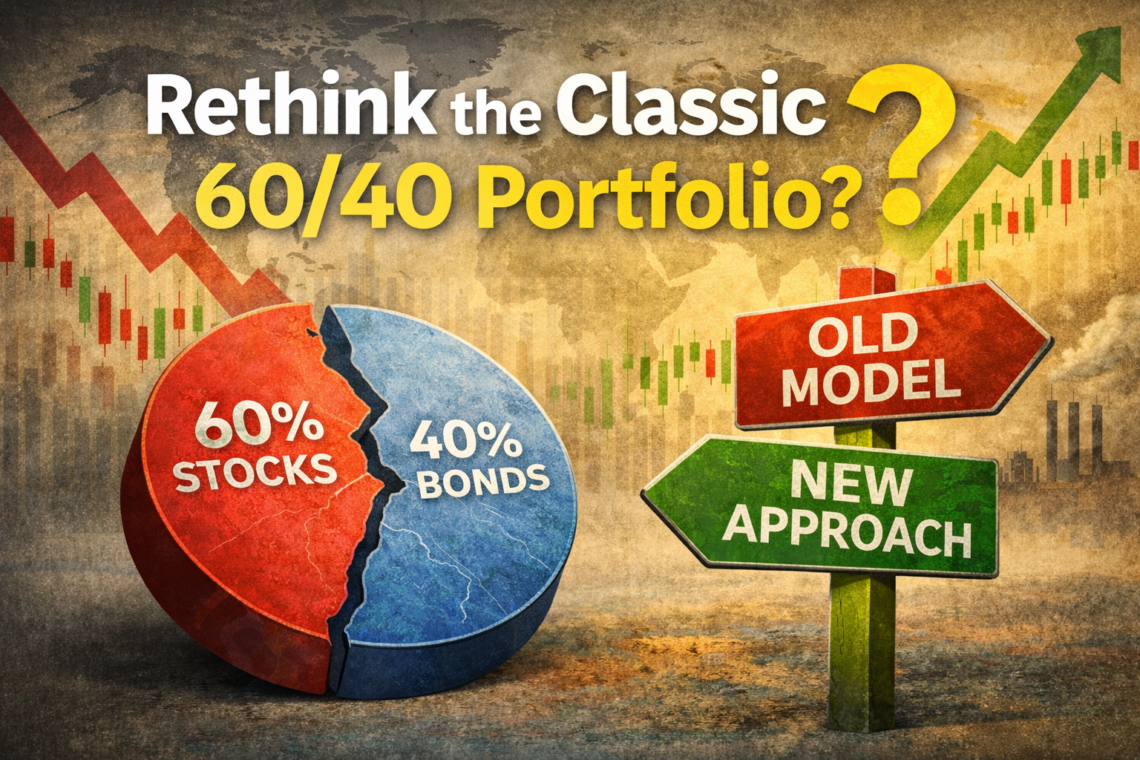
For decades, the 60/40 portfolio sat quietly at the center of global investing. Sixty percent equities for growth, forty percent bonds for stability. It wasn’t exciting, but it was dependable. More importantly, it offered psychological comfort: a sense that diversification alone could smooth uncertainty.
The question investors are now asking isn’t whether the 60/40 model ever worked. It clearly did.
The real question is whether a static balance still delivers flexibility in a world that is no longer static.
That shift in framing matters more than any tactical tweak.
When Stability Becomes Rigidity
The appeal of the 60/40 model was never just about returns. It was about predictability. Bonds were expected to cushion equity drawdowns. Equities were expected to outgrow inflation. Together, they created a portfolio that felt “finished.”
But the conditions that supported that relationship have changed.
Inflation no longer behaves as a brief anomaly. Monetary policy is less predictable. Geopolitical alignments are more fluid. And currency risk—long ignored in global portfolios—has returned as a meaningful variable. In that environment, a portfolio that never adapts can quietly drift from stability into rigidity.
This is why several institutional research groups, including Goldman Sachs Research, have begun reframing what a “world portfolio” should represent: not a fixed ratio, but a living structure that adjusts as conditions evolve.
Why This Matters Now
What makes this moment different is not volatility itself. Markets have always been volatile. What’s different is correlation.
There were long stretches when bonds reliably offset equity risk. In recent cycles, that relationship has weakened or even reversed. Rising rates hurt both asset classes at the same time. Currency swings amplified outcomes rather than smoothing them. The assumption that “diversified” automatically meant “defensive” proved fragile.
This doesn’t invalidate diversification. It reframes it.
Diversification today is less about owning two asset classes and more about owning different economic drivers—growth, inflation protection, liquidity, optionality—across time.
The Comfort Trap of the 60/40 Narrative
One reason the 60/40 model persists is that it simplifies decision-making. Once set, it removes the need to think. That simplicity is comforting, especially for long-term investors who want to avoid constant adjustment.
But comfort can hide trade-offs.
A static allocation assumes that future conditions will resemble the long-run average of the past. It assumes bonds will always act as ballast. It assumes currency exposure is neutral. These are not reckless assumptions—but they are assumptions nonetheless.
The risk is not that the model fails dramatically. The risk is that it underperforms quietly, locking capital into structures that respond slowly to structural change.
Active Tilts Are Not the Same as Constant Trading
When investors hear “active tilting,” many imagine frequent moves or speculative timing. That’s not what institutional research is pointing toward.
The shift is subtler. It’s about adjusting exposure among broad asset categories—equities, bonds, commodities, real assets, currencies—based on how their roles change across cycles. It’s about acknowledging that risk does not come from volatility alone, but from misalignment between portfolio structure and economic reality.
A portfolio that adapts occasionally can be less stressful than one that promises simplicity but delivers surprises.
For readers who occasionally pause to sanity-check how their current allocation would behave under different inflation or growth scenarios, this is often where the discomfort first shows up.
From Tactics to Life Design
This conversation matters beyond investment theory because portfolios are not abstract objects. They support real lives.
For people thinking in terms of financial independence, optionality often matters more than optimisation. A portfolio that is flexible may sacrifice some simplicity, but it gains resilience. It allows for changes in location, income structure, or time horizons without forcing major overhauls.
The classic 60/40 model offered certainty in construction. What many investors now seek is control in outcomes—not guaranteed returns, but the ability to adjust when circumstances shift.
That’s a subtle but important distinction.
Rethinking Diversification as a Principle
At its core, the move away from rigid models is not about abandoning discipline. It’s about redefining it.
Discipline doesn’t require sameness. It requires coherence.
A coherent portfolio aligns with how the world actually works, not how it once did. It accepts that inflation, policy, and currency dynamics are not background noise, but active forces. And it treats allocation as a framework for decision-making, not a rule to be followed indefinitely.
For readers who want to explore this idea more deeply—especially how portfolio flexibility intersects with long-term independence—the broader discussion around global asset exposure and optionality is often a natural next step within this site’s investing framework.
A Quieter Conclusion
The 60/40 model didn’t fail. It simply belongs to a different chapter.
What’s emerging in its place isn’t a new formula, but a mindset: one that values adaptability over elegance, and alignment over tradition. Investing has always been about preparing for an uncertain future. The tools we use to do that must evolve as the nature of uncertainty itself evolves.
In the end, the goal isn’t to outsmart the market. It’s to build a structure that can live with it.
Disclaimer: This article is for general information only and is not financial advice. You are responsible for your own financial decisions.

