Financial Independence and Retire Early — FIRE — often begins with a simple question:
How much is enough?
A FIRE calculator exists to help explore that question. But it does not — and cannot — give a definitive answer. Used well, it clarifies boundaries and trade-offs. Used poorly, it creates false certainty.
This article explains how to think about a FIRE calculator as a decision-making tool rather than a prediction engine — and how to use it in a way that supports long-term planning, flexibility, and optionality.
Why this calculator exists
The FIRE calculator was not built to tell you when you will retire.
It was built to help you understand what conditions would need to be true for financial independence to become possible.
Most people approach FIRE with a single target number in mind. That number often feels precise, comforting, and motivating. It is also usually misleading.
The purpose of a FIRE calculator is to move the conversation away from certainty and towards structure:
• How sensitive is your plan to spending levels?
• How much does savings rate matter relative to investment returns?
• What happens when timelines stretch, rather than compress?
By modelling these relationships, the calculator helps frame decisions — not make them for you.
What the calculator shows — and what it doesn’t
A FIRE calculator typically shows three core outputs:
• An estimated target savings amount
• A projected timeline based on saving and investing behaviour
• The interaction between expenses, returns, and time
These outputs are useful. But only if they are interpreted correctly.
What the calculator does show:
• How changes in savings rate affect your path
• How expenses shape the size of your required portfolio
• How compounding works over long periods
What it does not show:
• Future market behaviour
• Personal life changes
• Emotional responses to risk, boredom, or uncertainty
• The quality of life along the way
The calculator creates a structured thought experiment. It does not create a promise.
Key assumptions you should understand
Every FIRE calculation rests on assumptions. Ignoring them is the fastest way to misuse the tool.
Here are the most important ones to examine.
1. Investment returns
Most calculators assume a steady average return. Real markets do not behave that way. Volatility, drawdowns, and long flat periods matter — especially near the point of independence.
2. Expenses
Expenses are usually treated as stable or gently increasing. In reality, they are shaped by health, family, geography, and personal values. Small changes here often have a larger impact than changes in returns.
3. Time
The calculator assumes consistency: consistent saving, consistent investing, consistent behaviour. Life is rarely consistent for decades at a time.
4. Withdrawal logic
Many FIRE calculators embed a simplified withdrawal framework. These are useful heuristics, not guarantees. They work best as planning ranges, not rules.
Understanding these assumptions does not weaken the calculator’s value. It strengthens it.
A simple example in practice
Consider a person who spends 40,000 per year and saves aggressively.
A FIRE calculator might suggest:
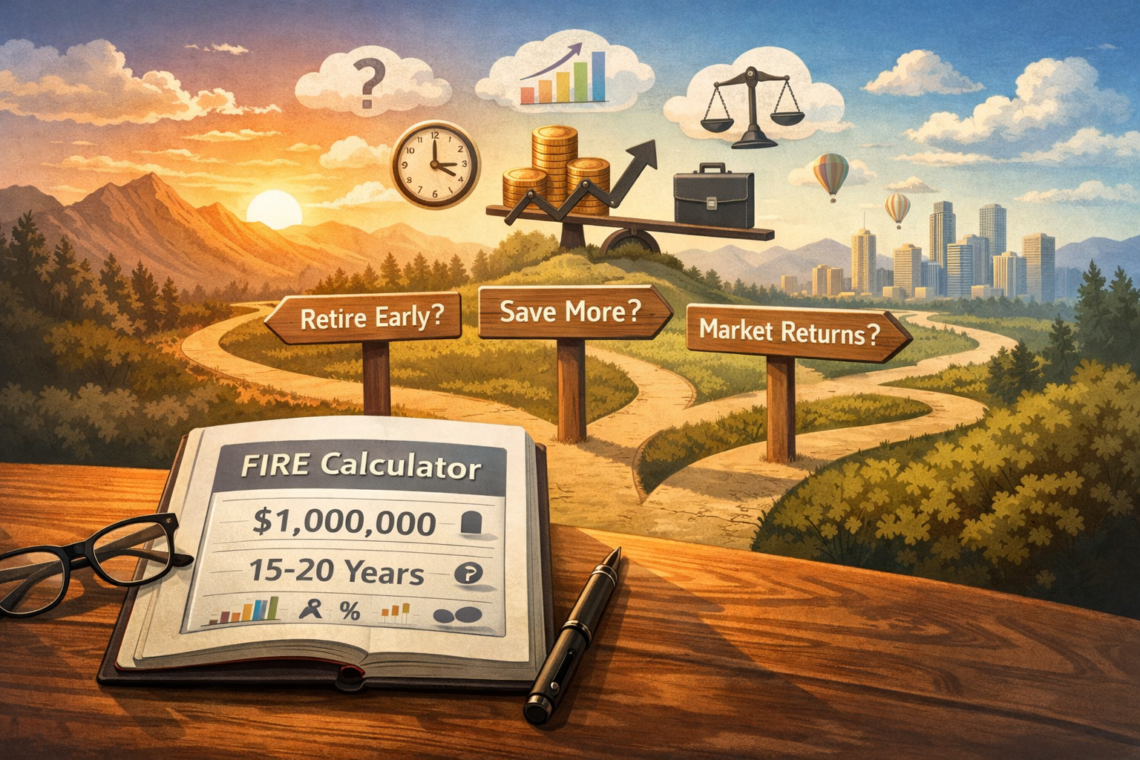
• A target portfolio of around 1,000,000
• A timeline of roughly 15–20 years, depending on assumptions
• A strong sensitivity to savings rate in the early years
Now change just one assumption.
If expenses rise to 50,000:
• The target portfolio increases significantly
• The timeline extends, even with the same income
If returns are lower than expected:
• Time becomes the dominant factor
• The “retire early” part of FIRE softens into “financial independence later”
The calculator makes these trade-offs visible. It does not judge them. That is the user’s role.
How to use this calculator well
A FIRE calculator works best when used as an exploration tool.
Here are a few practical guidelines.
First, treat results as ranges, not points.
If one number feels comforting, you are probably underestimating uncertainty.
Second, run multiple scenarios.
Change expenses, returns, and timelines deliberately. Notice which variables matter most.
Third, focus on direction, not deadlines.
Is your current behaviour increasing flexibility over time? That matters more than the exact year.
Fourth, revisit the calculator periodically.
Not to chase progress, but to update assumptions as life changes.
Finally, remember that independence is not binary.
Optionality grows gradually, long before a formal FIRE threshold is reached.
Common mistakes to avoid
One common mistake is treating the output as a contract with the future.
Markets do not sign contracts.
Another is assuming that higher returns can compensate for weak savings habits.
In most cases, behaviour matters more than forecasts.
A third mistake is ignoring lifestyle drift.
The calculator cannot protect you from changing preferences — only awareness can.
Lastly, many people delay using a FIRE calculator because they fear the result.
Avoidance does not reduce risk. Understanding does.
Final perspective
A FIRE calculator is not about retiring early.
It is about understanding how money, time, and choice interact.
Used responsibly, it helps you design a life with more flexibility and fewer forced decisions. It clarifies boundaries without pretending to remove uncertainty.
Financial independence is not a finish line.
It is a widening set of options.
A good calculator does not tell you where to stop.
It helps you see where you stand — and what paths remain open.
If you want to explore these paths more concretely, the FIRE calculator allows you to test different assumptions and see how they shape the boundaries ahead.
Disclaimer: This article is for general information only and is not financial advice. You are responsible for your own financial decisions.

