Loans are often framed as simple trade-offs.
Borrow an amount, pay it back over time, move on.
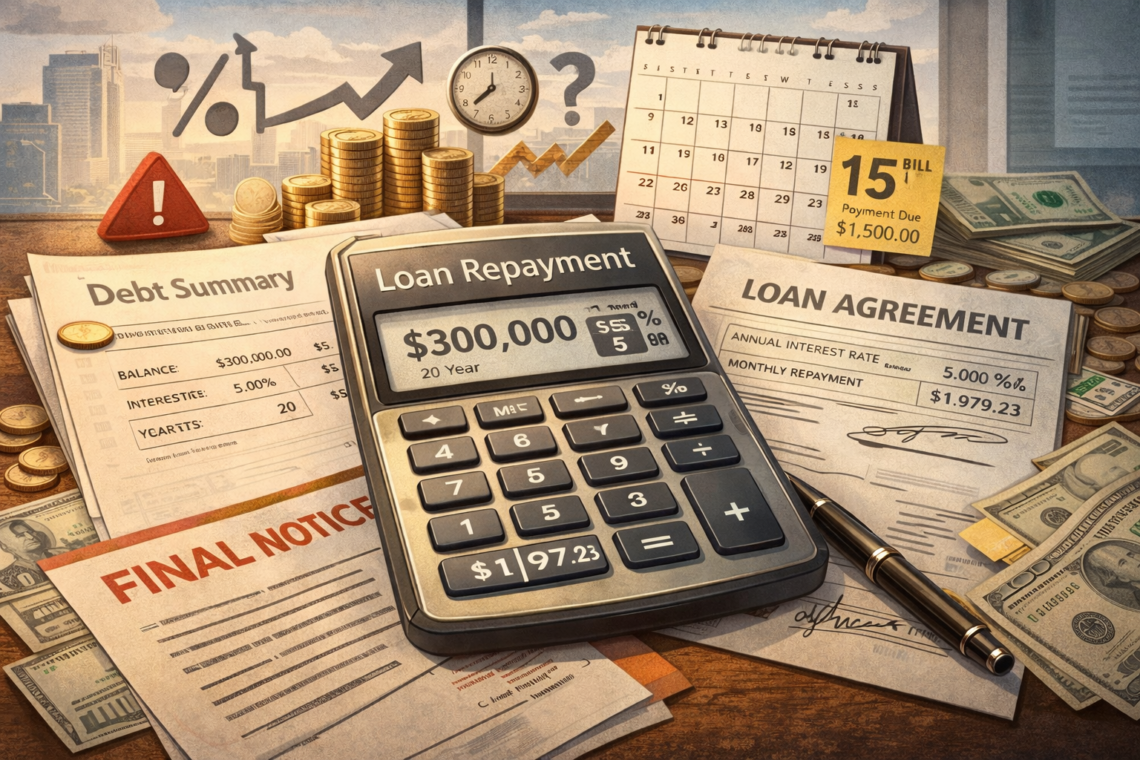
In reality, loan decisions quietly shape cash flow, risk tolerance, and future flexibility for years — sometimes decades. A loan repayment calculator exists to make those implications visible. Not to simplify them away, but to surface them clearly enough to be considered.
Used thoughtfully, the calculator supports better decision-making. Used carelessly, it can create a false sense of certainty around affordability and progress. This article explains how to use a loan repayment calculator as a planning tool — not a verdict.
Why this calculator exists
Most people approach borrowing with a single question:
Can I afford the repayments?
That question is necessary, but incomplete.
A loan repayment calculator exists to fill a specific gap in financial thinking. It shifts the focus from the loan itself to its ongoing impact on cash flow and choice. It helps answer questions that rarely surface during borrowing decisions:
• How much flexibility does this repayment structure leave?
• How sensitive is the loan to interest rate changes?
• What does “manageable” look like over time, not just today?
Rather than encouraging borrowing, the calculator is designed to clarify its cost — in money, time, and optionality.
What the calculator shows — and what it doesn’t
A loan repayment calculator typically shows:
• Regular repayment amounts
• Total interest paid over the life of the loan
• The length of time required to repay the balance
These outputs are useful, but only when interpreted in context.
What the calculator does show:
• How repayment size changes with loan term and interest rate
• The long-term cost of extending repayment periods
• The relationship between interest and time
What it does not show:
• Changes in income stability
• Future expenses or lifestyle shifts
• Emotional responses to debt
• Opportunity costs beyond interest
The calculator maps structure. It does not capture experience.
Key assumptions you should understand
Every loan calculation rests on assumptions. Understanding them is essential to using the calculator responsibly.
1. Interest rate stability
Most calculations assume a constant interest rate. In practice, rates can change. Even small shifts materially affect repayments over long periods.
2. Repayment consistency
The calculator assumes repayments are made on schedule, without interruption. Real life often introduces gaps, delays, or early repayments.
3. Loan term rigidity
Terms are treated as fixed. In reality, many borrowers refinance, restructure, or adjust repayments over time.
4. No behavioural friction
The calculation assumes rational behaviour — no missed payments, no stress-driven decisions, no fatigue. This is rarely how debt is experienced.
5. Cash flow isolation
The loan is considered in isolation, separate from other goals. In long-term planning, this separation rarely holds.
Changing any of these assumptions changes the meaning of the result.
A simple example in practice
Consider a loan of 300,000 with a fixed interest rate and a 25-year repayment term.
A loan repayment calculator might show:
• A predictable monthly repayment
• A substantial total interest cost over time
• A long but manageable timeline
Now change just one variable.
Shorten the term to 20 years:
• Repayments increase
• Total interest decreases
• Cash flow tightens, but long-term cost improves
Extend the term to 30 years:
• Repayments decrease
• Total interest rises significantly
• Flexibility improves in the short term, but declines over time
The calculator helps visualise these trade-offs. It does not tell you which version is better. That judgement depends on income stability, risk tolerance, and broader financial independence goals.
How to use this calculator well
A loan repayment calculator is most effective when used as an exploration tool.
First, compare multiple terms rather than searching for the lowest repayment.
Lower repayments often mask higher long-term costs.
Second, stress-test assumptions.
Adjust interest rates upward to understand sensitivity.
Third, view repayments as a percentage of flexible income, not total income.
This reframes affordability in practical terms.
Fourth, revisit calculations periodically.
Loans are dynamic; plans should be too.
Finally, consider how the loan affects optionality.
A repayment that limits future choices may be affordable, but costly in less visible ways.
Common mistakes to avoid
One common mistake is treating the minimum repayment as the “right” repayment.
Minimums are designed for lenders, not life design.
Another is focusing exclusively on interest rates while ignoring term length.
Time often matters more than percentage points.
A third mistake is using the calculator only once, at the start.
Debt evolves; understanding should evolve with it.
Lastly, many borrowers equate stable repayments with low risk.
Stability today does not guarantee resilience tomorrow.
Final perspective
A loan repayment calculator does not tell you whether to borrow.
It helps you understand what borrowing demands over time.
Used well, it clarifies boundaries rather than offering reassurance. It supports long-term planning by making trade-offs explicit and visible. It does not remove uncertainty — it frames it.
Debt is not only a financial decision.
It is a structural one.
A good calculator does not answer the question for you.
It helps you see the shape of the decision — and decide with greater awareness of the paths ahead.
If you want to explore this structure more concretely, the loan repayment calculator allows you to test different assumptions and see how they shape the trade-offs over time.
Disclaimer: This article is for general information only and is not financial advice. You are responsible for your own financial decisions.

