
Snapshot
Indicator name: Employment and Labour force participation rate (ages 15-64)
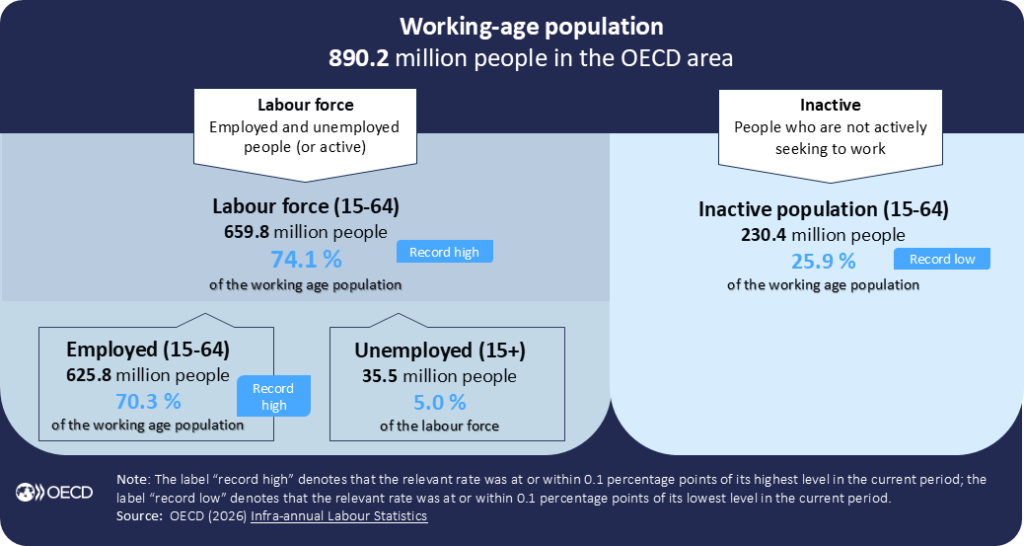
Current value (with exact date): Employment 70.3%, Labour force participation 74.1% (Q3 2025)
Upper reference range (historical stress / long-term upper bound): Not stated in this OECD release.
Lower reference range (historical low / pre-pandemic baseline): Not stated in this OECD release.
Reference ranges are positional context only. They are not targets, risks, or forecasts.
Indicator detail
Indicator name: Employment rate (OECD area)
Latest value: 70.3% (Q3 2025)
Comparison (previous period): → Unchanged from Q2 2025
Year-ago: Unchanged from Q3 2024
OECD average: Not applicable (this is the OECD aggregate).
Indicator name: Labour force participation rate (OECD area, ages 15-64)
Latest value: 74.1% (Q3 2025)
Comparison (previous period): → Unchanged from Q2 2025
Year-ago: Not explicitly stated at OECD-area level in this release
OECD average: Not applicable (this is the OECD aggregate).
Short Context
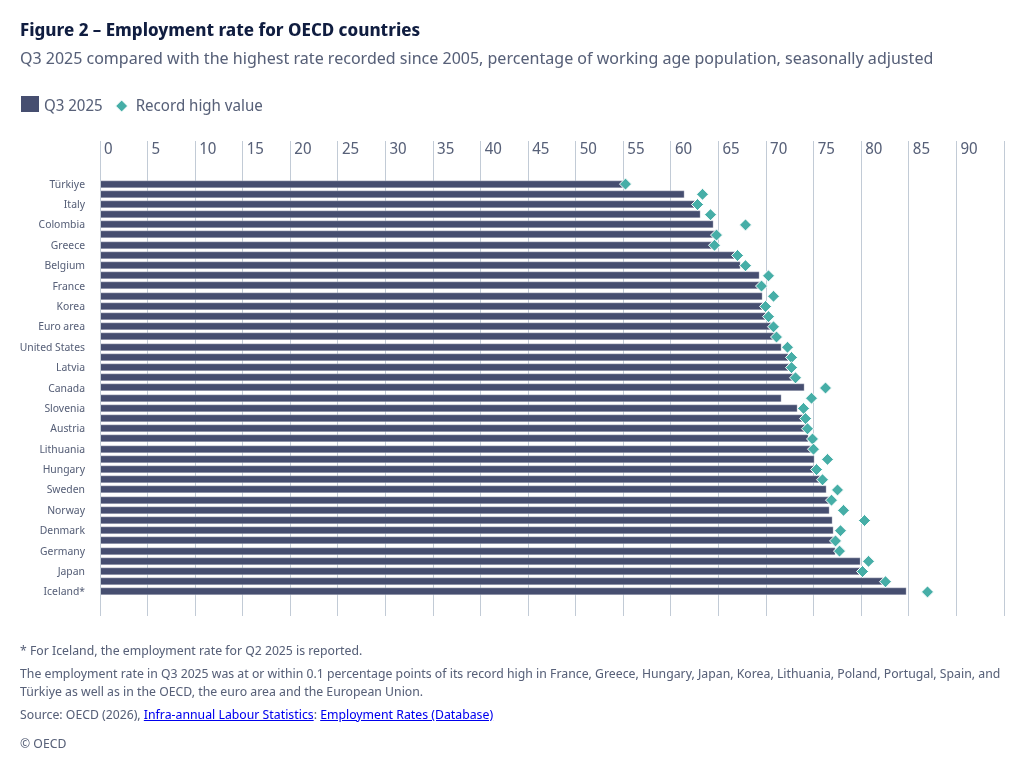
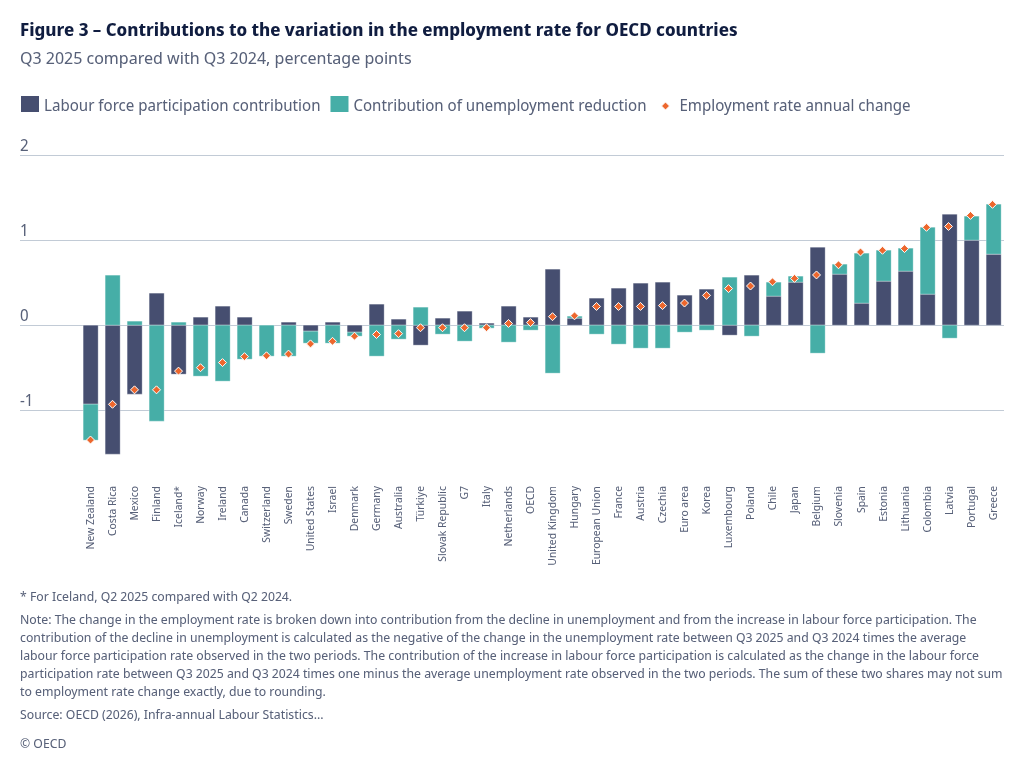
In Q3 2025, the OECD employment rate remained unchanged at 70.3%, maintaining a record-high level. Over the same quarter, employment rates were unchanged in 16 OECD countries, declined in 12, and increased in 9, indicating dispersion beneath the aggregate stability. Labour force participation among people aged 15 to 64 also remained at a record high of 74.1% in Q3 2025, with just over two-thirds of OECD countries reporting participation rates above this level. Compared with Q3 2024, the OECD employment rate was unchanged, with changes across countries primarily reflecting shifts in participation rather than unemployment.
Why this matters (Exactly 3 bullets)
- Constraint: With employment and participation rates holding steady at high levels, further aggregate gains depend more on participation dynamics than on cyclical labour absorption.
- Flexibility: Stability at the OECD aggregate level allows baseline labour-market assumptions to remain usable despite divergent country-level movements.
- Optionality: The range of outcomes is shaped by participation trends across countries, widening differences in labour supply conditions even when the aggregate rate is unchanged.
Economic Audit
This release confirms an existing baseline rather than shifting long-term assumptions. Employment and labour force participation rates in the OECD area remained unchanged in Q3 2025 at record levels, reinforcing a picture of structural stability at the aggregate level alongside continued cross-country divergence driven mainly by participation rather than unemployment.
Calcufinder context
Cost of living planning calculator — this release primarily informs the income stability and labour participation variables, rather than wage growth or price-level assumptions, as both employment and participation remained unchanged at the OECD aggregate level in Q3 2025.
Sources
OECD (primary):
• OECD — OECD employment and labour force participation rates remain at record highs in Q3 2025 (Statistical release, January 2026)
https://www.oecd.org/en/data/insights/statistical-releases/2026/01/labour-market-situation-updated-january-2026.html
Disclaimer: This article is for general information only and is not financial advice. You are responsible for your own financial decisions.

