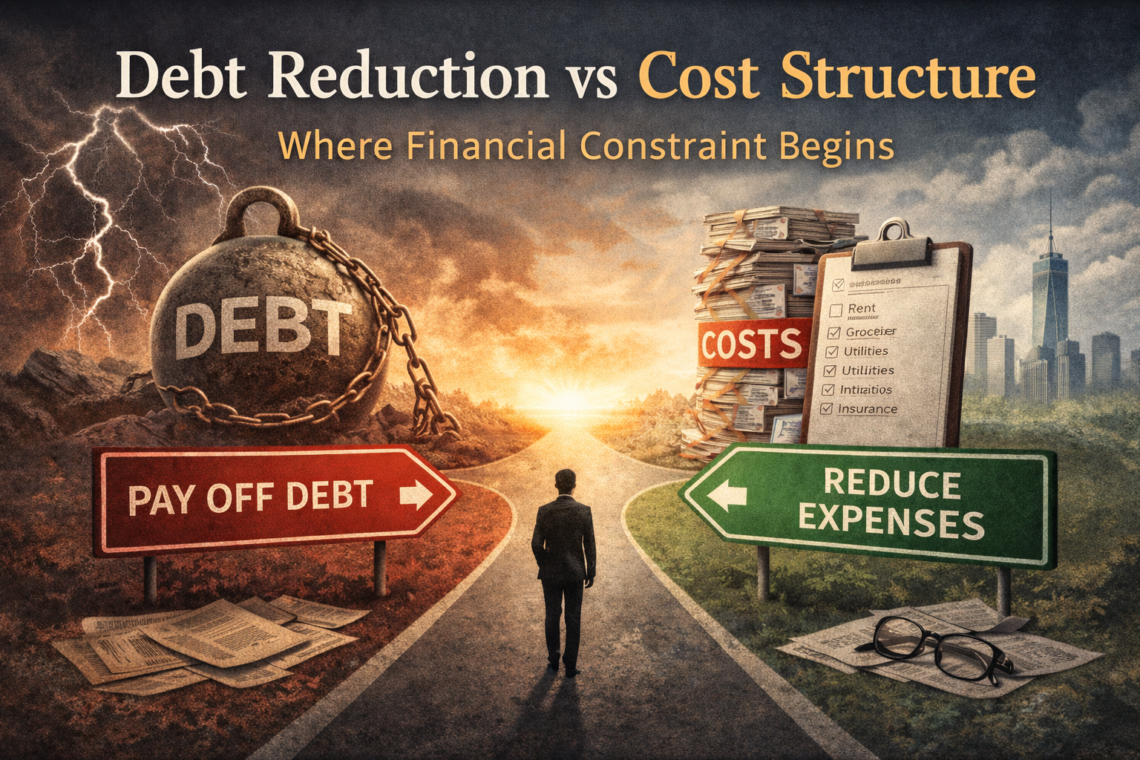
Most people do not wake up deciding between two calculators.
They face something more ordinary: income arrives monthly, expenses leave monthly, and somewhere in between sits a loan repayment.
The practical question is rarely dramatic. It sounds more like this:
With limited surplus cash, does reducing debt change my financial structure more meaningfully than redesigning my ongoing cost base?
This is not a moral decision. It is a systems decision.
Both paths are plausible. Both can improve stability. But they change constraints in different ways.
1) The Real Situation
Assume the following:
• Net household income: $6,000 per month
• Living expenses (excluding loan): $3,500 per month
• Loan repayment: $1,200 per month
• Interest rate: 6%
• Remaining loan balance: $120,000
• Monthly surplus before any change: $1,300
No crisis. No windfall. Just an ordinary balance sheet.
The decision variable: where to apply an additional $1,000 per month of deliberate adjustment.
2) Two Identical Starting Points, One Variable Changed
Scenario A — Accelerated Loan Repayment
Starting point
• $120,000 debt at 6%
• $1,200 minimum repayment
Timeline assumption
• Additional $1,000 per month directed toward principal
Key change
• Debt retired in approximately 5 years instead of 10
No lifestyle changes. Living costs remain $3,500 per month.
Scenario B — Cost Compression
Starting point
• Same $120,000 debt
• Same 6% rate
• Same $1,200 minimum repayment
Timeline assumption
• $1,000 per month used to permanently reduce lifestyle costs
• Living expenses reduced from $3,500 to $2,500
Debt repayment schedule unchanged.
At this stage, neither scenario is better.
They simply shift where structural pressure sits.
3) Concrete Divergence Over Time
Year 5
Scenario A
• Debt fully repaid
• Loan payment of $1,200 disappears
• Monthly fixed obligations fall to $3,500
Total structural expense: $3,500
Scenario B
• Debt balance still present (~$75,000 remaining)
• Living costs permanently reduced to $2,500
• Total structural expense: $3,700 ($2,500 + $1,200)
Despite lower lifestyle cost, total obligations remain higher because debt persists.
Year 10
Scenario A
• Five years debt-free
• Surplus accumulates at higher rate
• No interest expense exposure
Scenario B
• Debt only recently completed
• Interest cost paid across full term
• Lower lifestyle baseline remains in place
The divergence is subtle:
Scenario A removes a fixed obligation earlier.
Scenario B reduces the baseline cost permanently.
Stress Period: Income Falls 20%
Assume income drops from $6,000 to $4,800.
Scenario A (after Year 5)
• Fixed costs: $3,500
• Cushion remains: $1,300
Scenario B (Year 5)
• Fixed costs: $3,700
• Cushion: $1,100
Scenario B benefits more once the debt is cleared, but carries more exposure during the repayment window.
The difference is not dramatic.
It is structural.
4) Structural Effects, Not Performance
Cash Flow Stability
• Scenario A removes a compulsory outflow earlier.
• Scenario B lowers lifestyle dependency.
Timing Risk
• Scenario A concentrates sacrifice early, reduces risk later.
• Scenario B spreads risk across the full loan term.
Flexibility Under Stress
• Scenario A improves optionality once debt is gone.
• Scenario B improves baseline survival cost permanently.
Dependency on Conditions
• Scenario A depends on stable income for five intense years.
• Scenario B depends on sustained discipline in lower spending.
Neither protects against everything.
Each simply protects against different vulnerabilities.
5) Hidden Assumptions
Scenario A Requires:
• No major income shock during accelerated repayment
• Stable interest rate environment
• Behavioural consistency under pressure
Scenario B Requires:
• Permanent cost reductions are truly permanent
• Debt remains serviceable during downturns
• No rate spike increases repayment burden
One scenario makes risk visible (debt).
The other embeds risk quietly (longer exposure to interest and repayment obligation).
6) Where This Connects to Long-Term Independence
Financial independence is less about asset size than about structural obligation.
Debt represents a compulsory claim on future income.
Living expenses represent a recurring dependency on current income.
Reducing debt accelerates the removal of mandatory payments.
Reducing lifestyle costs lowers the minimum income required to remain stable.
The distinction becomes clearer when these variables are isolated rather than blended.
Two planning lenses help make that separation explicit:
A loan repayment structure clarifies how repayment speed, interest cost, and time horizon alter cash-flow release.
A cost baseline structure clarifies how fixed living expenses determine the minimum sustainable income required under stress.
In practical modelling terms, this is where a Loan Repayment Calculator and a Cost Living Planning Calculator serve complementary roles.
The first exposes how long structural obligations persist.
The second exposes how low your financial floor can realistically fall.
Neither tool answers the decision.
They simply reveal which constraint disappears first — debt, or dependency on income.
And in long-term independence thinking, the order in which constraints fall often matters more than the magnitude of wealth accumulated.
7) A Grounded Reflection
Financial decisions rarely hinge on dramatic turning points.
They hinge on which constraint remains longest.
Debt ties future income to obligation.
Living costs tie independence to required cash flow.
Over time, the difference between these structures is not measured in returns, but in forced commitments.
Seeing those commitments clearly does not dictate a path.
It simply changes the level at which the decision is made.
Comparison is not about choosing sides.
It is about seeing consequences earlier.
Disclaimer: This article is for general information only and is not financial advice. You are responsible for your own financial decisions.

