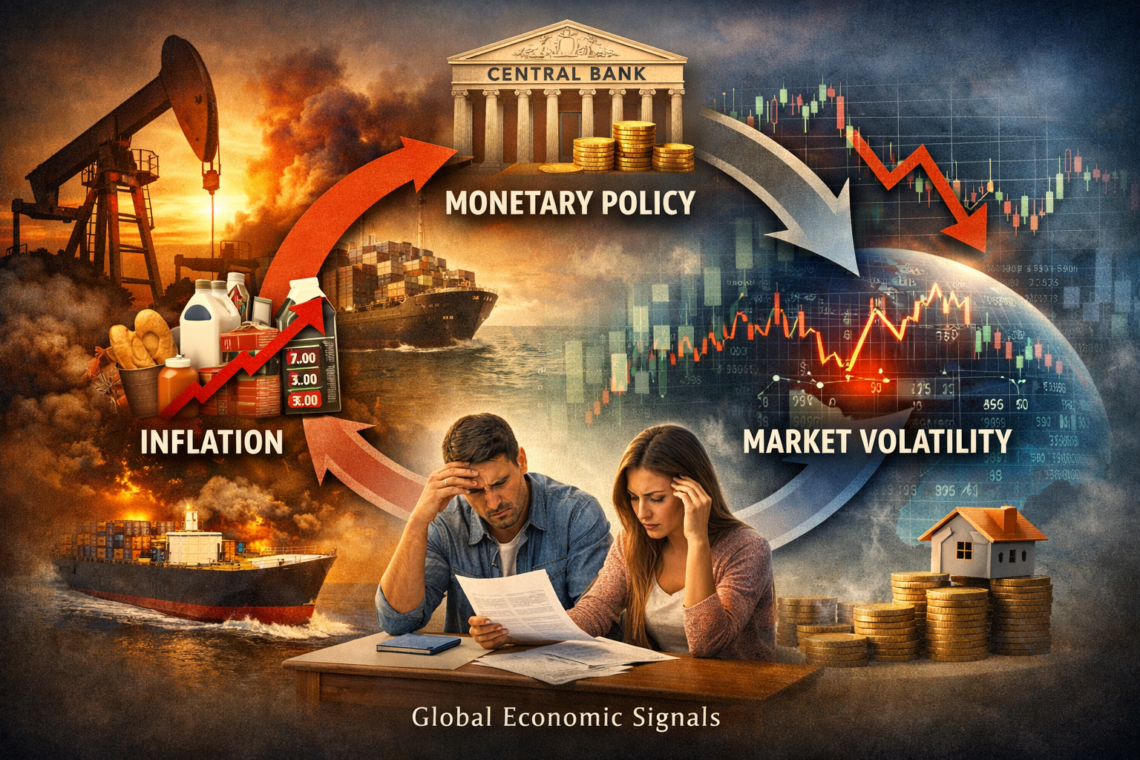
1. Energy Shock & Strait of Hormuz Disruption
This is the gravitational center of everything right now. Oil isn’t just rising—it’s being re-priced structurally due to physical supply risk. The Strait of Hormuz, a critical artery for global energy flows, is partially blocked, and that single constraint cascades into inflation, trade, and market volatility.
Key dynamics
• Brent crude above $100/barrel, first time in years
• Shipping disruption + tanker security concerns
• LNG supply risk (Qatar disruptions impacting ~20% of global supply)
• Air travel, logistics, and insurance costs rising simultaneously
Why markets care
Energy is the bloodstream. When it thickens, everything slows—and costs more.
2. Central Banks Trapped Between Inflation and Slow Growth
Central banks were already navigating a fragile landing. Now they’re being pushed into a corner:
• Oil shock → inflation risk
• Weak growth → pressure to ease
They can’t comfortably do either.
Key dynamics
• Federal Reserve, ECB, BOE, BOJ all in “wait-and-see” mode
• Rate-cut expectations repriced downward sharply
• Reserve Bank of Australia hiked rates, but narrowly (5–4 split)
• Inflation rising while GDP growth softens
Why markets care
This is the policy choke point. If central banks misstep, the system either:
• overheats (inflation spiral), or
• stalls (growth shock)
3. Global Market Volatility & Risk Repricing
Markets are no longer treating this as a short-term geopolitical scare. The tone has shifted from “headline risk” to structural repricing of risk assets.
Key dynamics
• Global equities falling or whipsawing
• Safe-haven flows are strengthening the US dollar
• Volatility indices rising sharply
• Investors rotating toward energy, away from growth sectors
• Supply chain concerns expanding (chips, logistics)
Why markets care
This is the moment sentiment breaks. When volatility becomes persistent, capital gets defensive—and that slows the real economy.
Economic Audit
These signals collectively suggest a shift in the operating environment rather than a continuation of the prior baseline, because they describe a single constraint moving through the system from physical energy disruption to cost transmission, then into monetary policy limitation, and finally into market repricing. The shared constraint is reduced flexibility: transport and energy flows become less reliable, inflation becomes less responsive to easing conditions in growth, policy choices become narrower, and asset prices adjust to that narrower range of operating conditions across regions and sectors.
Calcufinder context
Cost of living planning calculator — the primary variables affected in this environment are energy cost inputs, inflation sensitivity, household expense variability, and income stability as supply disruption, policy constraint, and market repricing feed into everyday cost structures.
Representative sources
• Reuters – https://www.reuters.com/business/finance/global-markets-view-usa-2026-03-16/
• Reuters – https://www.reuters.com/world/china/global-markets-view-europe-2026-03-17/
• Reuters – https://www.reuters.com/world/china/global-markets-wrapup-1-2026-03-13/
• Yahoo Finance – https://sg.finance.yahoo.com/news/energy-stocks-jump-goldman-sachs-193300639.html
Disclaimer: This article is for general information only and is not financial advice. You are responsible for your own financial decisions.

