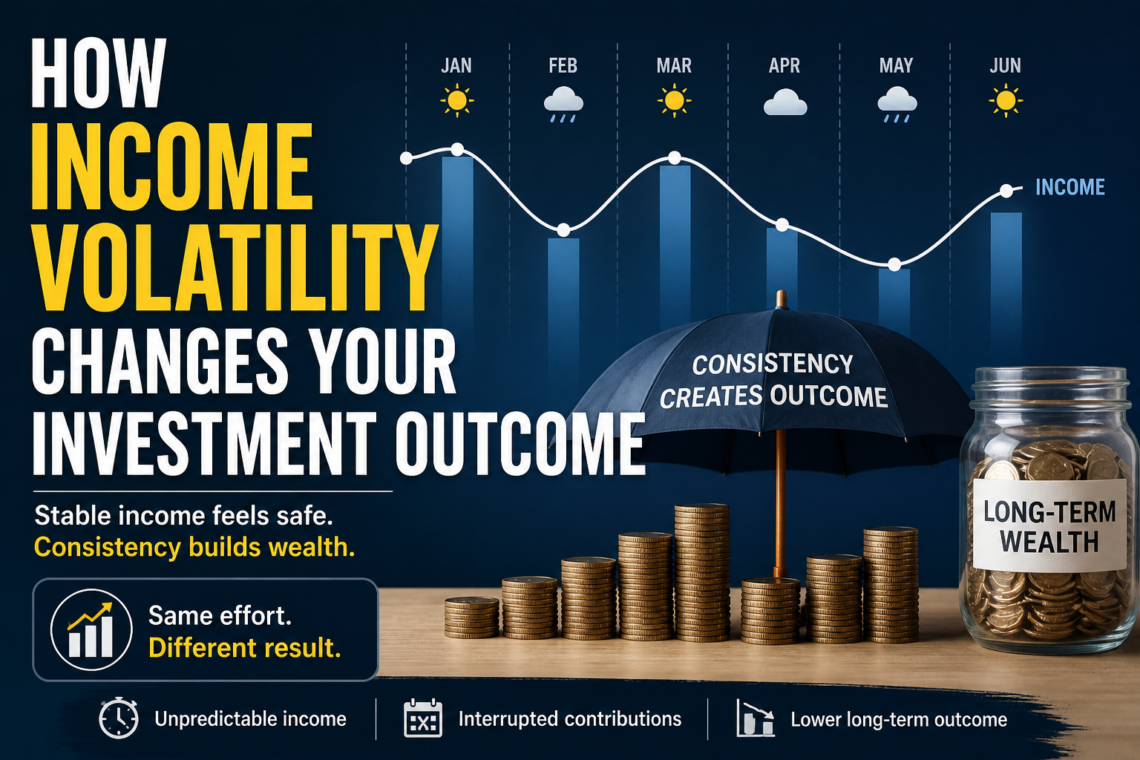
Most financial plans assume income arrives evenly.
Reality rarely does.
Income changes shape before it changes amount.
Some months expand.
Some contract.
The total annual income may remain similar.
The pattern does not.
And investment outcomes are shaped by the pattern
as much as the amount itself.
Section 1 — Core Mechanism of This Topic
Volatile income changes timing.
Not just capacity.
A stable income creates predictable contribution behaviour.
A volatile income interrupts it.
The disruption appears through uneven periods:
- delayed contributions
- inconsistent allocation
- fluctuating liquidity needs
- reactive spending adjustments
The issue is not always lower income.
It is irregular participation.
A contribution made late does not behave the same way as one made consistently.
Volatility changes sequence.
And sequence changes outcomes.
Section 2 — Where Plans Break
Income volatility rarely creates a single disruption.
It creates repeated adjustment.
Plans begin to shift:
- contributions become conditional
- investment timing becomes uneven
- liquidity buffers expand
- long-term allocation becomes reactive
The plan does not collapse. It drifts.
During stronger months, contributions increase.
During weaker months, participation slows.
Over time, the structure loses rhythm.
The gap does not appear immediately. It accumulates quietly.
Section 3 — The Missing Calculation
Most financial plans measure annual income.
Fewer measure income consistency.
The distinction matters.
Two people may earn similar yearly amounts.
Their outcomes may differ completely because:
- cash flow timing differs
- interruption frequency differs
- contribution consistency differs
What matters is not only how much income exists.
It is when it becomes available.
This is why examining how income translates into actual investable surplus through a scenario return calculator matters.
The missing variable is not income level.
It is income stability.
Section 4 — Structural Framework
Traditional budgeting frameworks assume regular intervals.
Monthly allocation models work best when:
- income timing is predictable
- expenses remain stable
- contribution schedules hold
Volatile income weakens these assumptions.
The structure becomes uneven:
- stronger periods absorb weaker ones
- planned allocation becomes delayed
- investment behaviour follows cash flow rather than strategy
The framework does not fail.
Its assumptions do.
Section 5 — Flexibility & Reality
Income volatility changes across time.
Often without permanence.
Common sources include:
- freelance work
- commission structures
- contract transitions
- reduced work periods
- career changes
The issue is not uncertainty alone.
It is irregular sequencing.
Periods of strong income often carry future instability within them.
Consistency becomes temporary.
Planning becomes adaptive.
Section 6 — Decision Layer
Volatile income changes how decisions are made.
Allocation becomes conditional:
- investment may pause temporarily
- liquidity may take priority
- contribution size may fluctuate
- timing becomes defensive
The structure responds to uncertainty.
A person with variable income does not allocate capital the same way every month.
There is no fixed allocation rhythm.
What matters is whether the structure can absorb uneven participation over time.
A plan built on predictable income assumptions struggles when predictability disappears.
What Actually Shapes the Outcome
Investment outcomes are not determined by income alone.
They are shaped by consistency of participation.
- Volatile income alters:
- timing
- contribution rhythm
- liquidity behaviour
- interruption frequency
Returns still matter.
But returns compound through participation.
When participation becomes uneven, the outcome changes with it.
A plan that assumes stable income patterns in unstable conditions is not a plan.
It is a projection.

