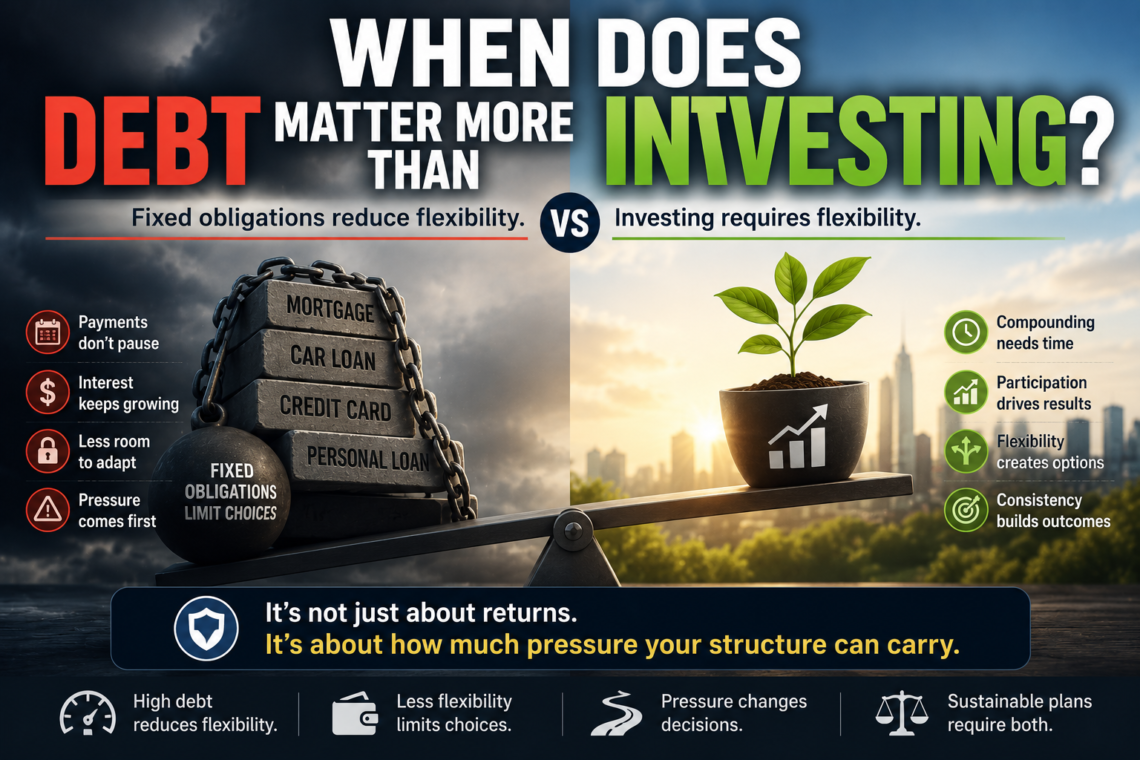
Debt and investing are often compared through returns.
Higher returns.
Lower interest rates.
But real financial pressure rarely behaves like a spreadsheet.
Debt changes behaviour before it changes net worth.
It alters timing.
It reduces flexibility.
It narrows the structure’s ability to absorb disruption.
And in certain conditions, that pressure matters more than investment growth itself.
Section 1 — Core Mechanism of This Topic
Debt creates recurring obligation.
Investing requires recurring participation.
The distinction matters because obligations do not pause easily.
Investment contributions may fluctuate.
Debt repayments usually do not.
The pressure appears through repetition:
- fixed repayment schedules
- ongoing interest accumulation
- reduced monthly flexibility
- constrained liquidity
Debt affects more than cash flow.
It affects optionality.
A structure carrying high fixed obligations responds differently to instability than one with lower recurring pressure.
The issue is not debt alone.
It is rigidity.
Section 2 — Where Plans Break
The strain rarely begins with a crisis.
It begins with reduced room to adjust.
As pressure increases:
- investment contributions become conditional
- repayment obligations remain fixed
- liquidity buffers shrink
- financial decisions become reactive
The plan does not collapse.
It drifts.
A structure under repayment pressure often prioritises continuity of obligation over continuity of investing.
Investment participation may continue temporarily.
But flexibility weakens underneath it.
The gap does not appear immediately. It accumulates quietly.
Section 3 — The Missing Calculation
Most financial comparisons focus on mathematical return differences.
Real financial behaviour responds to pressure tolerance.
A structure with significant repayment obligations behaves differently during disruption:
- investment pauses occur sooner
- liquidity becomes defensive
- contribution timing weakens
- optional spending contracts faster
The issue is not simply whether investment returns exceed borrowing costs.
It is whether the structure can continue functioning while carrying both simultaneously.
This is why examining how income translates into actual investable surplus through a investment vs debt payoff calculator matters.
The missing variable is not theoretical return spread.
It is repayment rigidity.
Section 4 — Structural Framework
Debt changes how financial structures allocate flexibility.
A repayment obligation behaves differently from discretionary allocation.
It carries priority.
As obligations increase:
• future cash flow becomes pre-allocated
• liquidity becomes thinner
• contribution adaptability weakens
The structure becomes less responsive to change.
Investment decisions may still appear affordable on paper.
But affordability and adaptability are not the same thing.
The framework does not determine whether debt is “good” or “bad”.
It reveals how much pressure is fixed before decisions are made.
Section 5 — Flexibility & Reality
The impact of debt changes across time.
Common shifts include:
- rising interest costs
- reduced income periods
- changing family obligations
- refinancing pressure
- employment instability
A repayment structure that feels manageable in stable conditions may behave differently during interruption.
Debt magnifies timing sensitivity.
The issue is not always repayment size.
It is how little room remains after repayment is required.
Section 6 — Decision Layer
This decision is rarely about maximising return.
It is about preserving flexibility under pressure.
A structure carrying significant obligations responds differently to uncertainty:
- investment participation becomes conditional
- liquidity preservation takes priority
- repayment continuity dominates allocation decisions
- financial timing becomes defensive
There is no universal threshold where debt automatically matters more than investing.
The distinction depends on how much rigidity the structure can absorb.
A structure with limited flexibility cannot behave the same way as one with wider margins.
The issue is not whether debt exists.
It is whether the structure still retains room to adapt.
What Actually Shapes the Outcome
Long-term outcomes are not shaped by return comparisons alone.
They are shaped by how much recurring pressure the structure can carry.
Debt and investing affect different layers of financial behaviour:
- one fixes future obligation
- one depends on future participation
The balance between them changes with pressure, timing, and flexibility.
What matters is not whether investing mathematically outperforms debt repayment.
It is whether the structure can continue operating while carrying both.
A plan that can only exist under ideal conditions is not a plan.
It is a projection.

