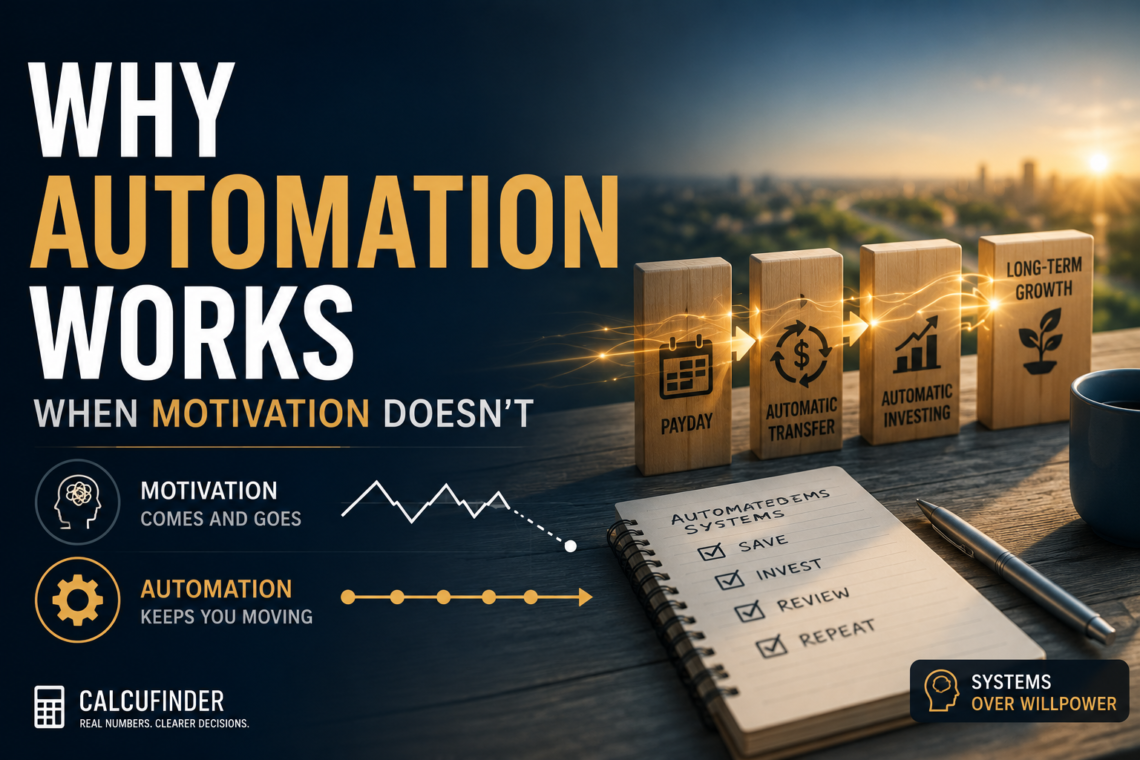
Most financial plans assume that good decisions will continue to be made.
Reality rarely works that way.
Motivation changes.
Attention shifts.
Priorities compete.
The strongest financial systems do not rely on making better decisions every month.
They reduce how often decisions need to be made.
Section 1 — Core Mechanism of This Topic
Every financial decision carries a cost.
Not a monetary cost.
A behavioural one.
Each month may require decisions such as:
- when to save
- how much to invest
- whether to delay a contribution
- which expense takes priority
None of these decisions appears difficult on its own.
Repeated often enough, they create friction.
Automation changes the structure.
The behaviour continues without requiring a fresh decision each time.
The advantage is not greater discipline.
It is fewer opportunities for inconsistency.
Section 2 — Where Plans Break
Most financial plans do not fail because the strategy changes.
They fail because the decision is postponed.
The pattern often looks familiar:
- contributions are delayed
- transfers are forgotten
- investing waits for a “better time”
- reviews become irregular
The plan does not collapse.
It pauses.
Each pause seems temporary.
Repeated often enough, it becomes the new pattern.
The gap does not appear immediately.
It accumulates quietly.
Section 3 — The Missing Calculation
Financial projections assume contributions occur.
They rarely measure how many decisions are required for those contributions to happen.
Two people may contribute exactly the same amount.
One makes a fresh decision every month.
The other relies on an established automated process.
The financial outcome begins the same.
The behavioural effort does not.
This is why examining how income translates into actual investable surplus through a scenario return calculator matters.
The missing variable is not expected return.
It is decision frequency.
Section 4 — Structural Framework
Automation does not improve a financial plan by changing the investment.
It improves the environment in which the investment happens.
A system with fewer repeated decisions often creates:
- fewer missed contributions
- fewer delays
- fewer emotional choices
- greater behavioural consistency
Automation removes unnecessary friction.
Not responsibility.
The framework is designed to support repetition without constant attention.
Section 5 — Flexibility & Reality
Life rarely provides uninterrupted focus.
Work becomes busy.
Family priorities change.
Unexpected events interrupt routines.
Automation allows essential financial behaviour to continue even when attention moves elsewhere.
The contribution may still be adjusted.
The routine is less likely to disappear.
Section 6 — Decision Layer
Not every financial decision should be automated.
Many should simply occur less often.
Reducing repeated decisions creates space for more meaningful ones.
Attention shifts from remembering routine tasks to evaluating important changes.
The objective is not removing choice.
It is reserving choice for the moments when it matters most.
What Actually Makes a System Reliable
Reliable financial systems are not built on permanent motivation.
They are built on reducing unnecessary behavioural demands.
Automation changes more than convenience.
It changes how consistently a financial plan can operate.
The fewer routine decisions a system requires, the more energy remains for decisions that genuinely deserve attention.
The goal is not perfection.
It is creating a structure that remains usable when conditions change.

