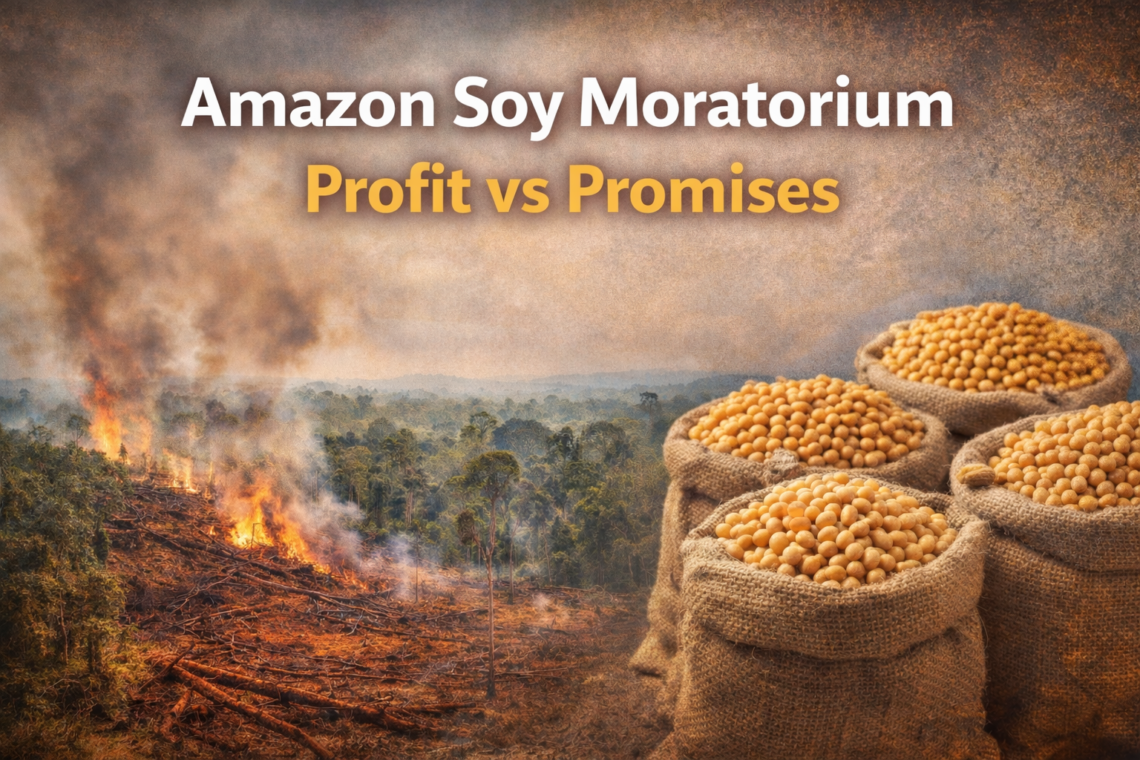
The story people are hearing sounds unsettling but familiar. A landmark environmental agreement helped slow deforestation in the Amazon, and now major commodity traders appear ready to step away—not because the science changed, but because the costs did.
At first glance, it feels like another example of sustainability losing out to short-term profit. But that reading is incomplete. What matters here is not just soy, or even the Amazon. It’s what this episode reveals about how environmental commitments actually survive—or fail—inside global markets.
What the Data Actually Says
The Amazon Soy Moratorium, introduced in 2006, prevented traders from buying soy grown on newly deforested land in the Amazon biome. Multiple assessments have shown it was highly effective, protecting millions of acres while allowing soy production to expand elsewhere. (Source: Reuters.)
Recent reporting indicates that some of the world’s largest soybean traders are now considering exiting the agreement. The motivation is not a rejection of environmental goals, but the rising tax and compliance costs associated with maintaining separate supply chains under Brazil’s evolving fiscal and regulatory framework. (Source: Reuters.)
In short: the moratorium worked environmentally, but its financial architecture is under strain.
Why This Matters Now
This moment arrives at a time when environmental policy is shifting from voluntary pledges to enforceable frameworks. Carbon pricing, land-use regulation, and supply-chain disclosure rules are becoming more complex—and more expensive to navigate.
The soy case highlights a structural tension: when environmental safeguards rely heavily on voluntary coordination, they remain vulnerable to changes in incentives. As long as compliance is optional and unevenly priced, firms will periodically reassess whether participation still makes commercial sense.
This is not unique to agriculture. The OECD has repeatedly noted that environmental outcomes weaken when policy costs are concentrated on a subset of actors rather than broadly shared. (Source: OECD.)
Common Misconceptions Worth Clearing Up
One assumption is that companies leaving the moratorium automatically means deforestation will surge. That outcome is possible—but not guaranteed.
Since the moratorium’s introduction, other mechanisms have emerged: satellite monitoring, investor pressure, and domestic enforcement tools that did not exist at the same scale two decades ago. (Based on World Bank and academic assessments.)
Another misconception is that sustainability fails because companies are inherently hostile to it. More often, it fails because incentives drift out of alignment. When environmental protection raises costs without offsetting benefits—such as tax neutrality or market access—participation becomes fragile.
The Second-Order Effects That Matter More Than the Headline
The more important signal lies beneath the soy market itself.
First, this episode reinforces that environmental progress increasingly depends on system design, not goodwill. Rules that survive are those embedded into pricing, taxation, or capital access—not those relying on reputational pressure alone.
Second, it highlights the growing role of investors and lenders. As supply-chain standards weaken, capital markets often step in to fill the gap, pricing environmental risk through financing terms rather than trade agreements. The IMF has noted that this shift—from trade-based enforcement to capital-based enforcement—is accelerating globally. (Source: IMF.)
Finally, it underscores a broader trend: environmental protection is becoming a balance-sheet issue, not just a moral one. That changes how firms respond—and how durable outcomes are.
Who Is Affected—and Who Is Not
More affected are commodity producers, traders, and regions where land-use rules directly shape costs and tax exposure. These actors face tighter margins and higher sensitivity to regulatory changes.
Less affected, at least immediately, are end consumers and diversified investors. The impacts here are indirect and gradual, filtering through supply chains rather than appearing as sudden shocks.
For individuals and long-term planners, the relevance is not soy prices, but the reminder that sustainability outcomes depend on incentive stability. Systems that rely on voluntary restraint tend to weaken when conditions change; systems that embed costs and benefits structurally tend to endure.
The Longer Trend Behind the Noise
Zooming out, this fits a wider global pattern. Environmental commitments are moving from informal agreements toward formal economic mechanisms—carbon markets, land-use pricing, and regulatory alignment across borders. The World Bank has repeatedly argued that environmental protection scales best when it is treated as economic infrastructure, not an add-on. (Source: World Bank.)
From that perspective, the Amazon soy debate is less a failure and more a stress test. It shows where frameworks hold—and where they need redesign.
A Calmer Way to Read the Outlook
It’s tempting to see this as a step backwards. A more accurate reading is that it exposes the limits of voluntary coordination in a world of shifting incentives.
Environmental progress rarely moves in straight lines. It advances, strains under cost pressure, and then re-emerges in more durable forms. The question is not whether sustainability survives market logic, but how well policy integrates that logic instead of fighting it.
For readers trying to make sense of global economic news, this distinction matters. Not every withdrawal signals collapse. Sometimes it signals the next phase—where ideals must be rebuilt into systems that can withstand the pull of profit without relying on it to behave altruistically.
Disclaimer: This article is for general information only and is not financial advice. You are responsible for your own financial decisions.

