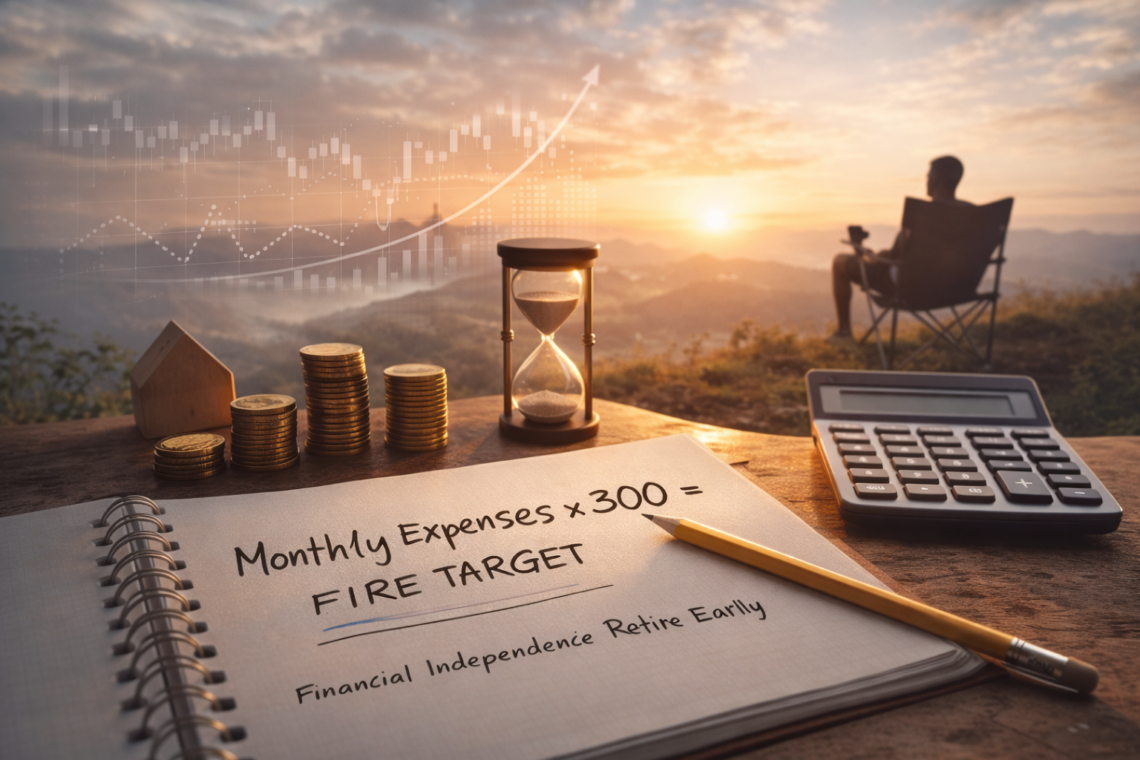
For years, the conversation around FIRE has been dominated by tactics: asset allocation, withdrawal rates, tax efficiency, optimisation. Useful, but often overwhelming. What tends to get lost is a quieter, more fundamental question: what level of life do you actually want to sustain—and what does that require, in plain numbers?
This is where the deceptively simple idea of monthly expenses multiplied by 300 becomes powerful. Not because it promises certainty, but because it reframes financial independence away from abstract wealth targets and back toward lived reality.
Why this framing matters now
Economic uncertainty has a way of amplifying complexity. Inflation, market volatility, shifting work patterns—all of it pushes people to search for ever more detailed plans. Yet complexity does not always produce clarity. In practice, the individuals who navigate uncertainty best are often those who anchor their thinking to variables they can actually observe and influence.
Your monthly expenses are one of those variables. They reflect choices, constraints, and values. When FIRE is expressed as a multiple of expenses rather than a headline net-worth figure, it becomes a question of structure, not aspiration.
What the “×300” idea is really saying
At its core, the formula is a monthly translation of the long-discussed 4% framework. Instead of starting with portfolio theory, it starts with life.
The logic runs quietly in the background: if long-term diversified portfolios have historically supported withdrawals around 4% per year, then annual spending multiplied by 25 provides a rough reference point. Converting that to months simply makes it more intuitive.
What matters is not the arithmetic itself, but what it forces into view. Spending becomes the driver. Not returns. Not market timing. Not income comparisons.
This often challenges a common assumption—that FIRE is primarily about earning more or investing smarter. In reality, it is just as much about understanding what level of consumption you are choosing to lock in.
The trade-offs hidden inside simplicity
A simple formula can obscure nuance if taken too literally. The “×300” figure is not a promise, nor a guarantee. It assumes variability will exist: markets will fluctuate, returns will be uneven, and life will not follow a straight line.
But simplicity has a compensating advantage. It makes trade-offs visible. Reducing ongoing expenses lowers the target dramatically. Adding even modest, flexible income reduces the pressure on a portfolio. Time becomes a variable to shape, not an enemy to defeat.
Many people find it useful, at this stage, to sanity-check how sensitive their plans are to changes in spending rather than returns—sometimes with a simple internal calculation or planning tool designed to model expense-driven outcomes.
Moving beyond the myth of “full retirement”
Another misconception the formula quietly dismantles is the idea that FIRE requires a complete exit from work. In practice, many people discover that partial independence changes everything. Covering half of one’s expenses through assets already shifts bargaining power, lifestyle flexibility, and risk tolerance.
This is why variations such as Semi-FIRE or flexible independence have gained traction. The goal is not zero work; it is zero obligation to work under stress, misalignment, or constraint. The expense-based framework accommodates this naturally, without needing a new philosophy.
From tactics to principles
Seen clearly, “monthly expenses × 300” is not a rule to follow. It is a lens. It encourages thinking in terms of resilience rather than optimisation, control rather than prediction.
It also aligns FIRE with a broader life-design principle: the less rigid your required cash flow, the more optional your future becomes. That optionality is what allows people to adapt—to markets, to health, to changing priorities—without constant recalibration.
If readers want to explore how different expense levels alter long-term flexibility, there is value in stepping back and examining their own numbers in a neutral, non-optimised way, simply to understand the shape of the path ahead.
A quieter definition of financial freedom
Financial independence, in this framing, is not about escaping work or hitting a dramatic number. It is about removing the mismatch between how you live and how you must earn.
The appeal of the “×300” idea lies in its restraint. It does not promise speed. It does not eliminate uncertainty. What it offers instead is orientation—a way to translate abstract finance back into the language of everyday life.
In a world crowded with complex strategies, that kind of clarity is not simplistic. It is grounding.

