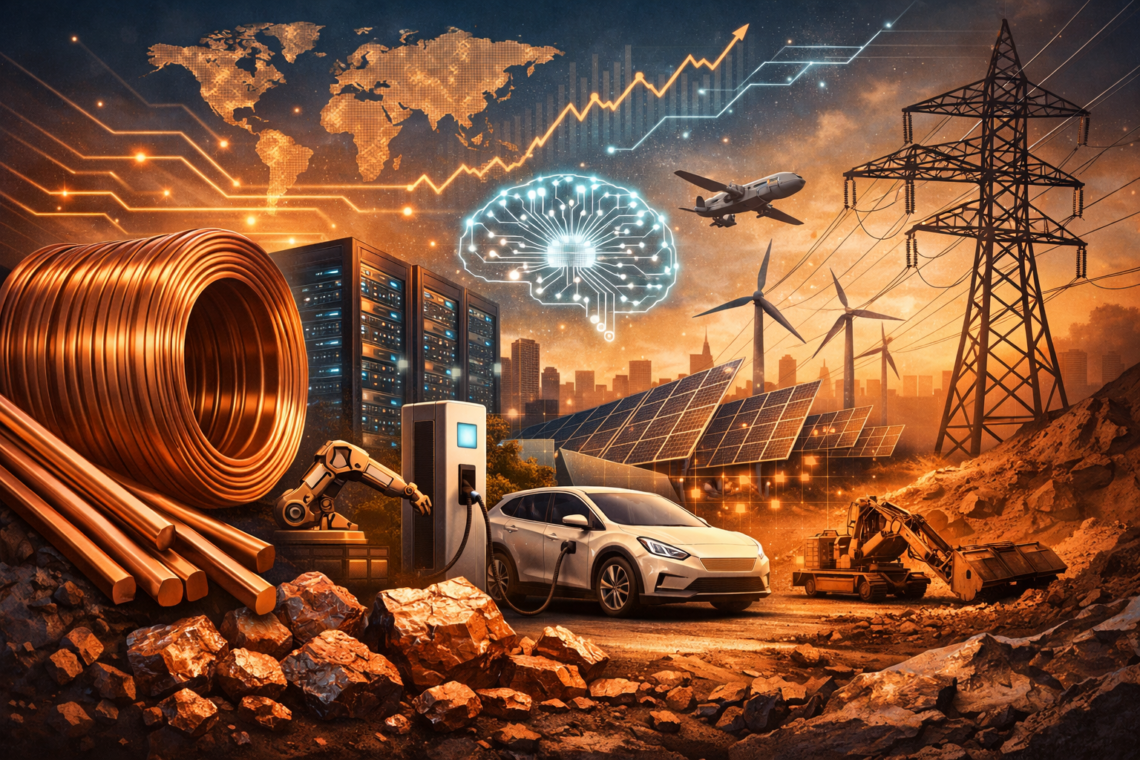
Copper has long been treated as a cyclical signal—rising with construction booms and fading when growth slows. That framing is becoming less useful. The more relevant question today is not whether copper prices move this year, but whether the next decade of global growth is quietly becoming dependent on a material that cannot be scaled quickly.
If that is the case, copper stops looking like a short-term trade and starts to resemble strategic exposure.
Why This Question Matters Now
Much of the dominant growth narrative still sounds digital: artificial intelligence, automation, electrification, data. These themes feel light, fast, and scalable. Yet beneath them sits a much heavier reality. Every AI model, data centre, electric vehicle, and renewable energy system ultimately depends on electricity moving through physical infrastructure.
Copper sits at the centre of that system. And as the economy becomes more energy-dense, the constraints around materials begin to matter again.
What the Data Is Actually Pointing To
Recent research and reporting converge on a simple idea: copper demand is broadening, not narrowing.
• AI and data centres are pushing up electricity demand and grid build-outs, and that pulls copper through power delivery and cooling systems. Reuters cited CRU estimates that copper demand from data centres has risen sharply since 2020 and could keep growing into 2030 as grid expansion accelerates. (Source: Reuters)
• Electrification more broadly—AI, defence, robotics, grids—adds new demand vectors on top of construction and consumer electronics. S&P Global projects copper demand rising materially through 2040 and warns of a large supply gap without meaningful new mining and recycling capacity. (Source: Reuters / S&P Global)
• Vehicles and clean energy are structurally copper-heavy. Industry data widely used in the sector places copper content around ~23 kg for an internal combustion vehicle and ~60–83 kg for plug-in hybrid or battery EVs. (Source: International Copper Association)
• Renewables and grids require large amounts of conductive material spread across geography. The International Copper Association has reported that renewable generators, on average, can use multiple times the copper of traditional generation, with the “8–12×” framing commonly cited. (Source: International Copper Association)
• Mines are not responding quickly. Copper supply is constrained by long lead times, project delays, and declining ore quality in mature regions. Reuters has reported on Codelco facing lower ore grades and execution delays. (Source: Reuters)
• Disruptions matter because the market isn’t cushioned by excess slack. Panama’s Cobre Panamá—previously around 1% of global copper output—was ordered shut in late 2023, and Reuters has continued to cover the economic and supply implications. (Source: Reuters)
Put plainly, the story is less “EVs will save copper” and more “electrification is expanding the surface area of copper demand, while supply adjusts slowly.”
Clearing Up a Persistent Misconception
Copper is still often viewed through the lens of property cycles, particularly in emerging markets. When construction slows, the assumption is that copper demand must weaken. That relationship has not disappeared—but it is no longer dominant.
The marginal demand today comes from energy intensity rather than building volume. Data infrastructure, electrified transport, and grid reinforcement do not scale down easily when growth softens. They are embedded in how modern economies function.
For investors, this distinction matters. It shifts copper from being a cyclical signal to a structural input.
Supply Elasticity as the Strategic Constraint
From an investment-strategy perspective, the critical variable is supply responsiveness. Copper supply remains notably inelastic.
Even when prices rise, new production takes a decade or more to materialise. Existing mines face declining ore quality, rising costs, and increasing environmental constraints. In key producing regions, water scarcity and regulatory friction further limit expansion (Source: Reuters).
This creates an asymmetric setup: demand can expand with system-level change, but supply cannot follow quickly. Over long periods, assets tied to such constraints tend to retain strategic relevance through cycles.
Trade-Offs Beneath the Theme
This does not make copper a frictionless investment story. Structural importance brings trade-offs. Capital intensity increases. Project timelines lengthen. Political and environmental factors play a larger role. Price volatility remains part of the landscape.
But these characteristics separate long-term positioning from short-term speculation. Copper’s relevance is not about quarterly momentum; it is about whether electrification and data infrastructure can proceed without it. At present, there is no scalable substitute.
What This Means for Portfolio Thinking
For individual investors, this is less about forecasting prices and more about recognising where long-term capital is likely to accumulate. As growth becomes more infrastructure-heavy, exposure to materials that underpin energy and transmission can act as diversification across economic regimes, not just asset classes.
Copper represents the physical layer beneath many of today’s digital narratives.
From Theme to Principle
Seen through this lens, copper is not just a commodity theme. It is a signal that constraints are re-entering the growth equation. When efficiency gives way to resilience, and ambition meets physical limits, assets tied to essential infrastructure tend to age better than those reliant on frictionless scaling.
This does not require urgency. It requires perspective.
A Grounded Outlook for the Decade Ahead
The next decade is unlikely to be defined by a single boom. It will be shaped by how economies manage the transition to higher energy intensity with limited physical resources. Copper happens to sit at one of those intersections.
Its strength as a long-term investment theme lies not in excitement, but in inevitability. When growth becomes heavier and slower, positioning for durability often matters more than chasing the next story.

