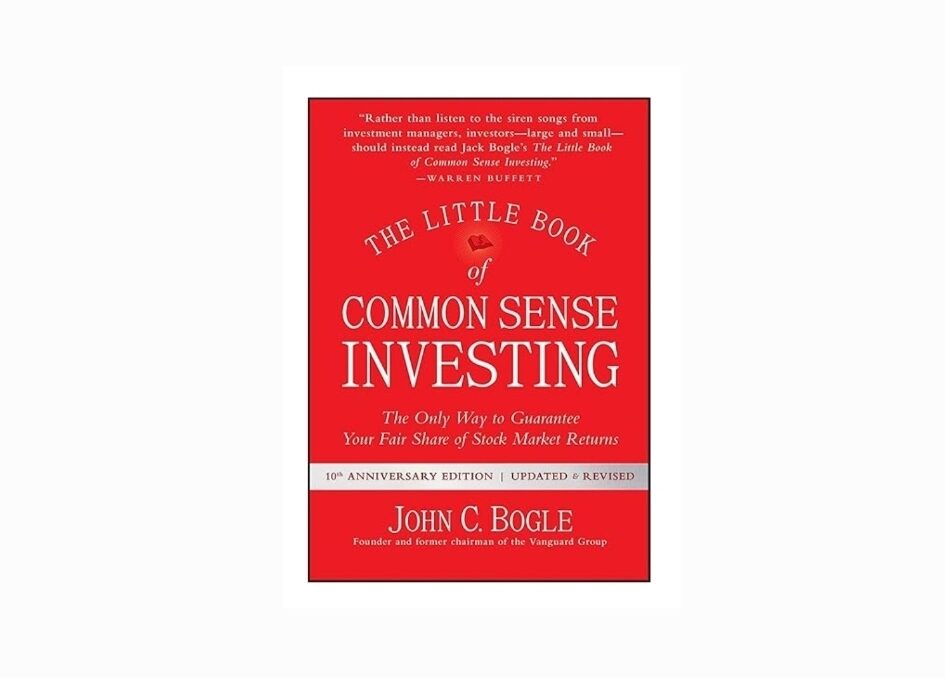
What if the real challenge in investing is not choosing the right assets, but learning to live with the fact that certainty is unavailable?
That quiet question sits beneath The Little Book of Common Sense Investing by John C. Bogle. The book is often associated with index funds and low costs, but its deeper contribution is philosophical. It asks what kind of financial system allows an ordinary person to remain invested, patient, and psychologically intact over decades.
The book as context, not a manual
Bogle wrote in response to a system that steadily made investing more complex, more expensive, and more dependent on constant decision-making. His answer was disarmingly simple: instead of trying to outsmart the market, own it.
This is not presented as a clever tactic. It is offered as a way to remove unnecessary friction between a person and their long-term goals. The book assumes that most investors already know what to do in theory. The harder question is whether they can keep doing it when markets become uncomfortable.
The core idea: participation beats prediction
At the centre of Bogle’s thinking is a clear tension between control and certainty. Markets cannot be predicted with consistency, but participation can be controlled. Costs can be controlled. Behaviour can, at least partially, be shaped.
Owning the entire market through a broad index is less about diversification as a technical concept and more about acceptance. It acknowledges that growth is uneven, cycles are inevitable, and individual judgement is often distorted by emotion. Rather than fighting those realities, the approach incorporates them.
For FIRE-minded investors, this matters because financial independence depends less on brilliance than on endurance. The strategy that works is the one you can follow without constant intervention.
Translating simplicity into real decisions
Seen through a life-design lens, this idea extends beyond portfolio construction. Complexity has a cost, not just in fees but in attention. Every additional choice invites second-guessing, comparison, and the temptation to act at the wrong moment.
A simple investment structure frees cognitive space. That space can be redirected towards work that compounds differently: developing skills, building side projects, or designing a life with lower fixed expenses. The less energy spent monitoring markets, the more energy remains for decisions that actually increase optionality.
This reframing is subtle but powerful. Investing becomes a background system rather than a central occupation. Money works quietly while life happens in the foreground.
Risk as fragility, not fluctuation
Bogle’s philosophy also challenges how risk is understood. Risk is not primarily about volatility; it is about fragility. A system that requires constant adjustment is fragile because it depends on perfect timing and emotional discipline.
By contrast, owning the market accepts temporary declines as part of the price paid for long-term participation. The risk being managed is not short-term loss, but the risk of being forced out—by fear, complexity, or the need to be right too often.
This perspective aligns closely with FIRE as optionality rather than an exit date. The aim is not to optimise returns at all costs, but to build a structure that survives stress. That broader framing of financial independence is explored further in a reflection on FIRE as optionality rather than a fixed destination.
How this changes perspective
Read this way, The Little Book of Common Sense Investing is less about markets and more about self-knowledge. It invites a reassessment of ambition. Not “how much can I make?” but “how much complexity am I willing to live with?”
Owning everything is not an attempt to dominate outcomes. It is a decision to step out of constant comparison and let time do its work. The reward is not excitement, but durability.
An open-ended question
If the market will always reflect collective emotion as much as fundamental value, then the most important choice may not be what you invest in.
It may be how much uncertainty you are willing to accept in exchange for a system that gives you time, flexibility, and the freedom to focus elsewhere.
What would change in your life if investing became quieter—and everything else had more room to grow?

