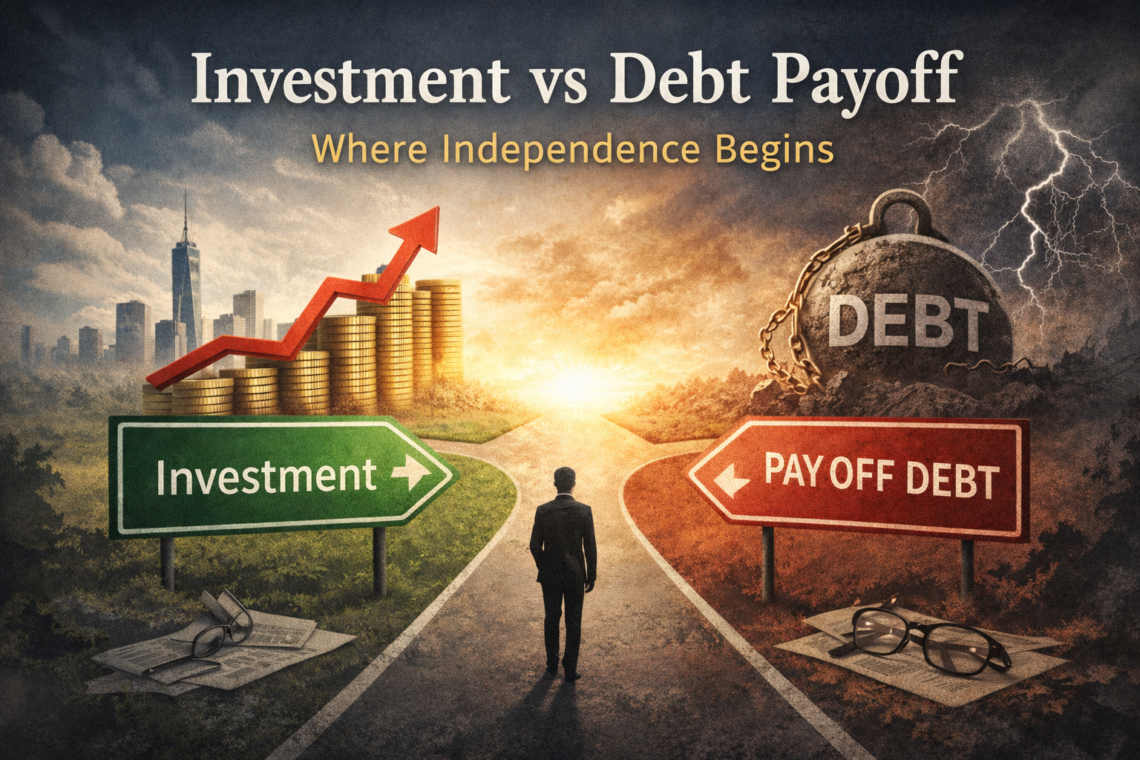
Most people who aim for financial independence do not start with a portfolio decision.
They start with a constraint.
There is income coming in.
There is debt outstanding.
There is a desire to invest.
The real decision is rarely ideological. It is structural:
Should surplus cash be directed toward investing, or toward eliminating debt first?
This is not a moral question. It is a timing question.
1) Framing the Real Decision
Consider a realistic starting position:
• $120,000 annual income
• $20,000 available annually for allocation
• $80,000 remaining mortgage or loan balance at 6% interest
• 25-year horizon toward financial independence
Nothing unusual. No extreme assumptions.
The constraint is clear: capital cannot go in two directions simultaneously.
2) Two Plausible Scenarios
Scenario A — Invest While Maintaining Debt
Starting point
• $80,000 debt at 6%
• $20,000 per year invested in diversified assets
• Minimum required debt payments only
Timeline assumption
Debt amortises gradually over time.
Key assumption
Investment returns exceed the effective cost of debt over the long run.
Scenario B — Eliminate Debt First
Starting point
• $80,000 debt at 6%
• $20,000 per year directed toward accelerated repayment
• Investing begins only after debt is cleared
Timeline assumption
Debt eliminated in approximately four years.
Key assumption
Reduced liabilities improve cash flow and risk resilience before compounding begins.
Both paths are internally consistent.
Neither is extreme.
3) A Concrete Numeric Divergence
To observe structural divergence, assume a moderate 7% long-term average market return. No projections, simply a working baseline.
Year 5
Scenario A
Investments ≈ $115,000
Remaining debt ≈ $60,000
Scenario B
Debt fully cleared
Investments just beginning ≈ $20,000
At this point, Scenario A shows higher net invested capital.
Scenario B shows zero liabilities.
The balance sheet shape differs more than the total value.
Year 10
Scenario A
Investments ≈ $290,000
Debt largely amortised
Scenario B
Investments ≈ $240,000
No debt for six years
The gap narrows. The compounding clock in Scenario B began later but without liability drag.
Stress Period Example (Year 8 Downturn)
Assume a 25% market decline combined with temporary income disruption.
Scenario A
Investment balance drops significantly
Debt obligation remains fixed
Cash flow pressure increases
Scenario B
Investment balance drops
No debt servicing requirement
Cash flow flexibility preserved
The divergence during stress does not relate to returns.
It relates to obligations.
4) Structural Effects, Not Performance
The difference between these scenarios is not return optimisation. It is constraint exposure.
Cash Flow Stability
• Scenario A maintains leverage longer.
• Scenario B reduces mandatory outflows earlier.
Timing Risk
• Scenario A depends more heavily on favourable early returns.
• Scenario B depends more on post-debt compounding.
Flexibility Under Stress
• Scenario B preserves optionality sooner.
• Scenario A preserves compounding exposure sooner.
Each protects against a different type of risk.
5) Hidden Assumptions
Scenario A Works If:
• Market returns remain broadly above borrowing costs.
• Income remains stable.
• Emotional discipline persists during downturns.
Scenario B Remains Viable If:
• Investment opportunities later remain adequate.
• The compounding delay does not materially shorten the time horizon.
• Liquidity needs do not require re-borrowing.
Neither path is fragile by design.
But each depends on different variables remaining stable.
6) Where This Connects to Financial Independence
FIRE is often framed as an investment milestone.
In practice, it is a liability milestone.
Independence emerges not only from asset growth but from reduced mandatory obligations.
Directing capital toward debt elimination shortens the duration of structural dependency.
Directing capital toward investing lengthens exposure to compounding.
The relevant question is not which produces the higher terminal value.
It is which structure preserves optionality across a full economic cycle.
Tools such as an Investment vs Debt Payoff Calculator exist to surface these trade-offs explicitly. They do not dictate behaviour; they make timing assumptions visible.
When the baseline assumptions are made explicit, the emotional weight of the decision tends to decrease.
7) A Neutral Perspective
Both scenarios move toward independence.
They simply travel different risk paths.
One accelerates compounding while maintaining obligations.
The other reduces obligations before accelerating compounding.
Comparison does not decide the outcome.
It clarifies what must remain stable for the plan to hold.
Financial independence rarely depends on choosing the “right” asset.
It depends on understanding the constraints embedded in the structure chosen.
And that understanding, more than the outcome itself, is where FIRE actually begins.

