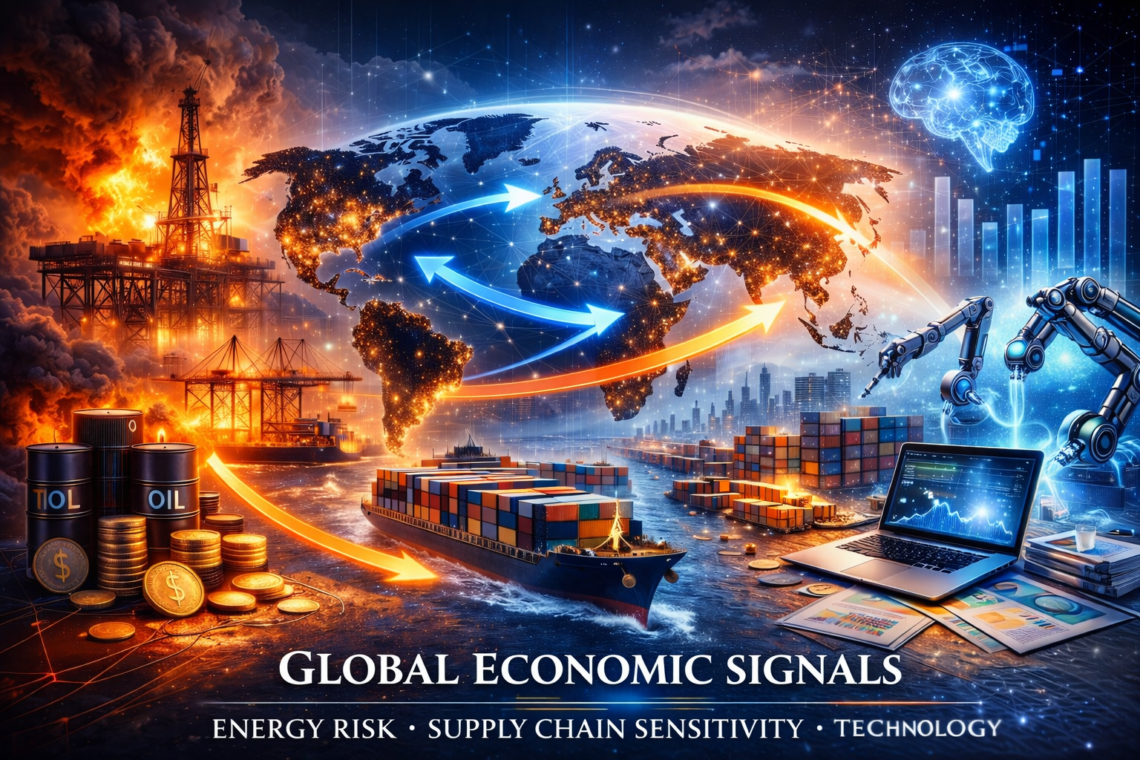
Signal 1 — Energy supply risk is being repriced through logistics
Over the last few days, coverage has centred on Middle East escalation feeding directly into oil pricing and shipping routes. The practical constraint is not “price moves” in isolation. It is the reappearance of transport chokepoints and rerouting risk as a live input into costs.
Signal 2 — Trade routes and delivery timelines are becoming less dependable
Reporting has highlighted shipping firms adjusting or pausing routes in response to security conditions. This is a real-economy signal because it touches lead times, insurance, and working-capital needs across borders, even when demand conditions have not changed.
Signal 3 — AI uncertainty is being treated as a macro variable, not a tech story
Market coverage is increasingly framing AI as an economy-wide disruption channel, with attention on how it may reshape labour demand and sector winners/losers. The constraint is that business planning assumptions can change faster when technology adoption becomes uneven across industries.
Why this matters
• Constraint: Cost and delivery planning tightens when energy and logistics risks become event-sensitive rather than trend-driven.
• Flexibility: Core activity can still run on existing demand assumptions, but operational buffers (timing, funding, inventory tolerance) matter more than usual.
• Optionality: The range of outcomes widens across input costs, delivery cycles, and income stability because shocks can arrive through supply, not only through demand.
Economic Audit
Taken together, these signals reinforce an existing baseline rather than establishing a new one: the world economy can still operate, but it is operating with a higher “friction premium”. The shared constraint is not a single forecastable path for growth or rates. It is a less stable operating surface, where supply chains, shipping access, and technology-driven adjustments can shift constraints quickly across regions.
Calcufinder context
The Global portfolio allocation calculator fits this environment because it treats return volatility, income stability, and currency risk as explicit variables, rather than assuming a single smooth global cycle.
Sources
• Reuters — https://www.reuters.com/business/energy/oil-jumps-us-iran-conflict-escalates-disrupts-shipping-2026-03-01/
Disclaimer: This article is for general information only and is not financial advice. You are responsible for your own financial decisions.

