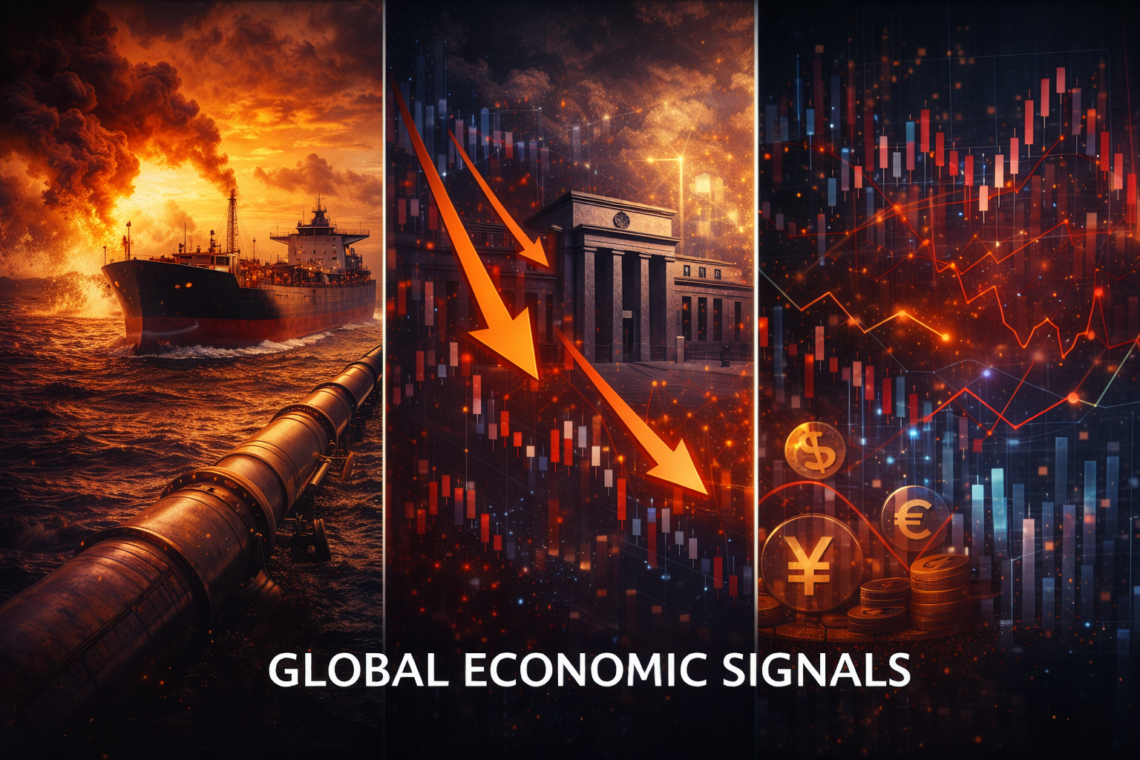
Signal 1 — Energy supply risk has re-entered the global baseline
Recent reporting has focused on rising geopolitical tension affecting expectations for energy supply and shipping routes. Oil prices and freight costs have responded quickly to the possibility of disruptions in major transit corridors. The constraint is that global energy pricing is again reacting to geopolitical developments rather than purely to demand conditions.
Signal 2 — Central banks face renewed inflation uncertainty
Energy price volatility has reintroduced uncertainty into inflation expectations across multiple economies. Policymakers in several jurisdictions have emphasised that commodity shocks complicate the timing and direction of monetary policy decisions. The relevance is cross-border: a single energy shock affects inflation assumptions in many economies simultaneously.
Signal 3 — Financial markets are repricing geopolitical risk
Global markets have adjusted through currency movements, volatility shifts, and demand for perceived safe-haven assets. The response is not confined to one region or asset class, indicating a broader reassessment of geopolitical risk. Financial conditions are therefore being influenced by geopolitical developments rather than only by domestic economic indicators.
Why this matters
• Constraint: Energy supply uncertainty introduces tighter assumptions for inflation stability and global transport costs.
• Flexibility: Core economic activity indicators and institutional growth assessments remain broadly usable as baseline planning references.
• Optionality: The range of outcomes for currencies, asset volatility, and funding conditions widens when geopolitical risk influences market pricing.
Economic Audit
Taken together, these signals reinforce an existing global baseline rather than establishing a new economic regime. International institutions continue to frame global growth as broadly stable, but the operating environment remains sensitive to geopolitical developments that influence energy markets, inflation expectations, and financial conditions simultaneously. The shared constraint is therefore not demand weakness but higher sensitivity of global pricing and policy assumptions to geopolitical events.
Calcufinder context
Global portfolio allocation calculator — variables most affected in the current environment include return volatility, currency exposure, and cross-region income stability, which may shift when geopolitical risk alters market pricing dynamics.
Sources
• Reuters — Oil prices rise as conflict elevates supply risks
https://www.reuters.com/business/energy/oil-rises-expanding-us-israeli-conflict-with-iran-elevates-supply-risks-2026-03-03/
• Reuters — Iran conflict disrupts oil supply to Asian countries
https://www.reuters.com/world/asia-pacific/iran-conflict-disrupts-oil-supply-asian-countries-dependent-middle-east-2026-03-02/
• Reuters — Iran war threatens ECB’s inflation outlook
https://www.reuters.com/business/iran-war-threatens-ecbs-good-place-schnabel-warns-2026-03-06/
• Reuters — Global markets react to Middle East conflict
https://www.reuters.com/world/china/global-markets-wrapup-1-wrapup-1-pix-2026-03-03/
Disclaimer: This article is for general information only and is not financial advice. You are responsible for your own financial decisions.

