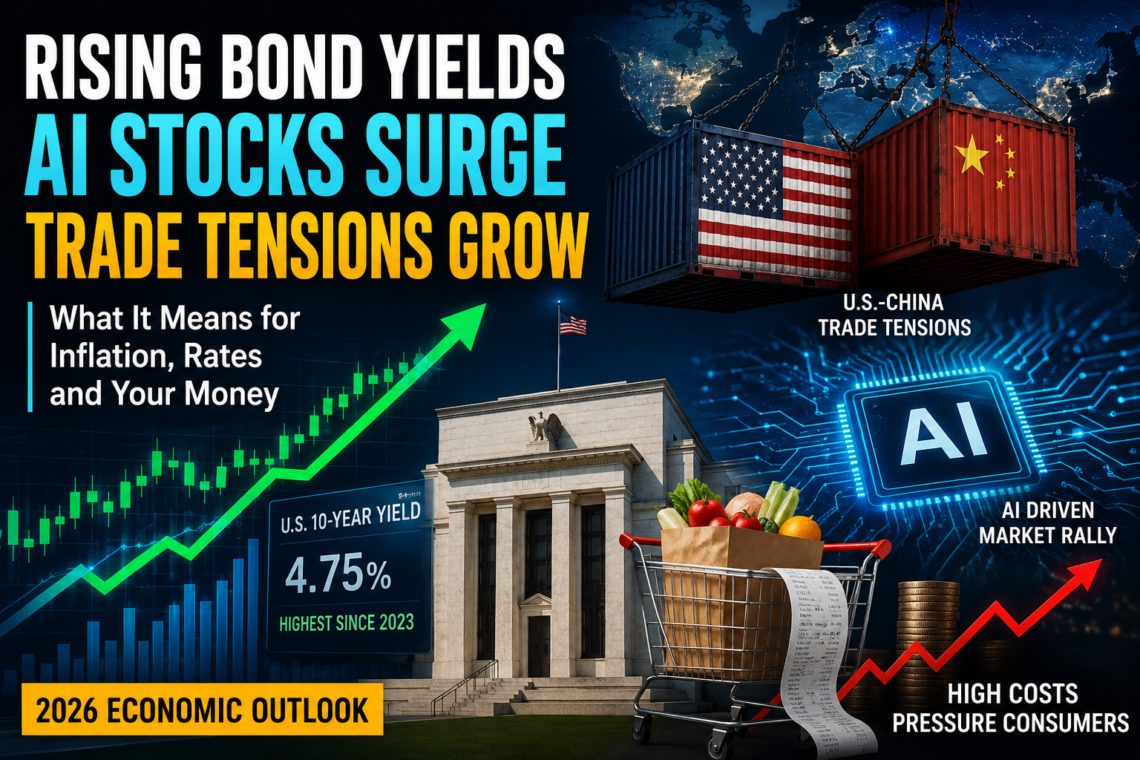
Signal 1. Inflation Persistence and Bond Yield Pressure Reduce Expectations for Rate Cuts
What’s happening:
- U.S. Treasury yields remained elevated as markets reassessed the timing of potential central bank rate reductions.
- Oil prices and services inflation continued to influence inflation expectations across developed economies.
- Financial markets reduced assumptions that the U.S. Federal Reserve would move quickly towards monetary easing.
Why this matters:
Higher long-term yields increase financing costs across sovereign debt markets, corporate borrowing, and household credit systems simultaneously. This changes how capital is priced across the global economy, particularly for sectors dependent on refinancing and long-duration investment assumptions. The repricing also affects equity valuation frameworks, pension allocations, and fiscal flexibility for governments carrying elevated debt loads.
What elevates it:
- Long-dated sovereign bond yields remained near multi-year highs.
- Inflation concerns increasingly shifted from goods prices towards services and energy-linked pressures.
- Market positioning adjusted away from rapid rate-cut expectations.
Signal 2. U.S.-China Trade Friction and Supply Chain Realignment Reshape Industrial Flows
What’s happening:
- G7 finance discussions included renewed focus on trade fragmentation and industrial imbalances.
- U.S. officials signalled limited urgency around extending tariff-related arrangements with China.
- Coverage across Asia and Western markets highlighted continued restructuring of supply chains around strategic industries and critical minerals.
Why this matters:
Trade fragmentation alters production geography, inventory structures, and capital allocation decisions across multinational systems. Supply chain diversification increases operational redundancy costs while reducing dependence on concentrated manufacturing hubs. These adjustments also interact with inflation dynamics because duplication of industrial capacity and strategic sourcing reduces efficiency advantages previously embedded in global trade integration.
What makes this critical:
- Critical minerals and semiconductor supply chains remained central to industrial policy discussions.
- Reshoring and friend-shoring continued influencing manufacturing investment patterns.
- Trade policy increasingly overlapped with national security frameworks.
Signal 3. AI Equity Momentum Continues While Consumer Conditions Remain Constrained
What’s happening:
- Technology equity coverage remained concentrated around AI investment demand and semiconductor earnings expectations.
- Major equity indices continued receiving support from a narrow group of large-cap technology companies.
- Consumer-focused reporting across multiple outlets highlighted ongoing pressure from borrowing costs and living expenses.
Why this matters:
Equity market performance and household financial conditions are operating under different constraint structures. Capital continues concentrating in sectors associated with productivity expansion and infrastructure investment, while household balance sheets remain sensitive to interest rates and cost pressures. This divergence affects consumption durability, earnings distribution across sectors, and the transmission mechanism between financial markets and broader economic activity.
This breaks the usual playbook:
- Equity leadership remained concentrated despite restrictive financing conditions.
- Consumer pressure persisted alongside elevated asset market valuations.
- Productivity optimism and financing constraints operated simultaneously within the same market cycle.
Economic Audit
These signals collectively suggest a shift in the operating environment rather than reinforcement of a prior baseline. Higher financing costs, supply-chain restructuring, and concentrated capital allocation are interacting through the same constraint channel: the rising cost of maintaining efficiency within a fragmented and capital-intensive global system. Trade realignment increases structural production costs, persistent inflation limits monetary flexibility, and equity concentration reflects capital preference towards sectors perceived as capable of absorbing elevated financing and infrastructure demands. The system is increasingly organised around resilience, strategic redundancy, and capital selectivity rather than low-cost global integration.
Calcufinder context
The global portfolio allocation calculator becomes sensitive to variables including long-term bond yields, regional equity concentration exposure, inflation assumptions, currency movement, and sector allocation weighting.
Representative Sources
- Reuters
– https://www.reuters.com/business/global-bonds-tumble-flaring-inflation-spooks-investors-2026-05-15/
– https://www.reuters.com/world/china/global-markets-global-markets-2026-05-15/
- FT
– https://www.ft.com/alphaville?
- Bloomberg
– https://www.bloomberg.com/professional/insights/category/trading/?pg=83&
– https://www.bloomberg.com/professional/insights/type/report/?pg=6&
– https://www.bloomberg.com/professional/insights/category/markets/page/4/?pg=37&
- WSJ
– https://www.wsj.com/economy/central-banking/how-eight-tumultuous-years-pushed-jerome-powell-and-the-fed-to-the-limit-96388c46?
– https://www.wsj.com/economy/japans-economy-accelerated-in-first-quarter-backing-case-for-rate-hikes-2a7c5f55?
– https://www.wsj.com/economy/week-ahead-for-fx-bonds-u-s-inflation-data-trumps-china-visit-in-focus-f78f06d3?
– https://www.wsj.com/economy/do-tariffs-cause-inflation-new-studies-offer-surprising-answer-20d56367?
– https://www.wsj.com/podcasts/take-on-the-week/the-consumer-shock-from-tariffs-isnt-over-when-will-prices-peak/5890075e-1174-4910-aa92-87cbe2d775de?
– https://www.wsj.com/opinion/trump-heads-to-beijing-with-a-strong-hand-a5a3b131?
– https://www.wsj.com/opinion/economy-gdp-ai-investment-tariffs-pce-index-480c8431?
- CNBC
– https://www.cnbc.com/technology/?
– https://www.cnbc.com/markets/?
– https://www.cnbc.com/economy/?
- Nikkei Asia
– https://asia.nikkei.com/economy?
– https://asia.nikkei.com/business/technology?
- The Economist
– https://www.economist.com/topics/finance-and-economics
– https://www.economist.com/topics/business
– https://www.economist.com/technology-quarterly?
Coverage Signals
- Bloomberg coverage highlights the interaction between persistent inflation expectations and elevated sovereign bond yields across developed markets.
- FT and WSJ coverage reflects increasing focus on the structural effects of trade fragmentation, industrial policy, and supply-chain regionalisation.
- Reuters coverage indicates that tariff negotiations, energy pricing, and sovereign financing conditions are being treated as interconnected macro constraints rather than isolated developments.
- CNBC coverage highlights continued concentration of equity market momentum within AI-linked technology firms despite restrictive financing conditions affecting households and smaller businesses.
- Nikkei Asia coverage reflects how semiconductor supply chains, strategic manufacturing relocation, and critical mineral access are increasingly linked to geopolitical alignment rather than purely economic efficiency.
Disclaimer: This article is for general information only and is not financial advice. You are responsible for your own financial decisions.

