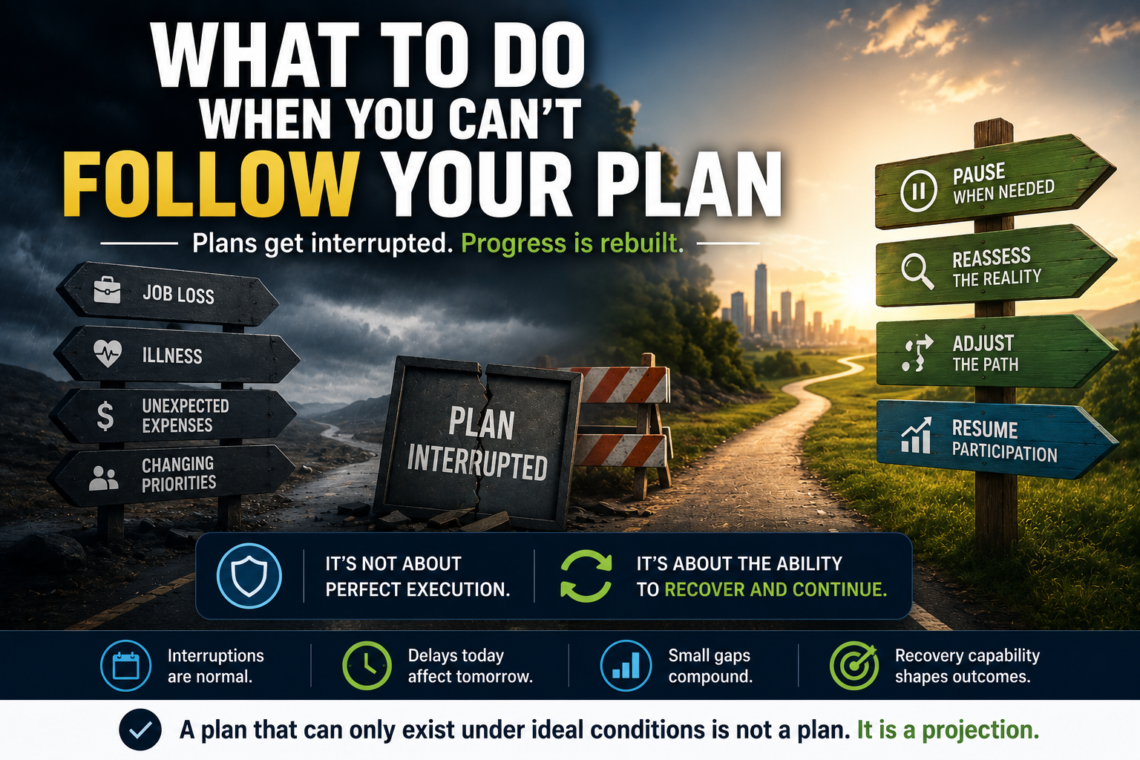
Most financial plans are evaluated while they are being followed.
Their real test begins when they are not.
A contribution is missed.
An expense appears.
A priority changes.
The plan remains the same on paper.
But the conditions supporting it no longer do.
The question is not whether disruption occurs.
It is how the structure responds when it does.
Section 1 — Core Mechanism of This Topic
Most plans assume continuity.
Life does not.
Financial plans are built around repetition:
- recurring contributions
- recurring income
- recurring behaviour
Disruption interrupts that sequence.
The interruption may be caused by:
- a job transition
- illness
- family obligations
- unexpected expenses
- reduced income
The issue is not the event itself.
It is the break in participation.
A plan designed around uninterrupted execution behaves differently once execution stops.
Section 2 — Where Plans Break
The first disruption rarely causes the greatest damage.
The response to the disruption does.
A common pattern emerges:
- contributions are paused
- reviews are postponed
- assumptions remain unchanged
- recovery is delayed
The plan does not collapse.
It drifts.
The original target remains visible.
The path leading to it changes.
Small interruptions become longer.
Temporary pauses become new behaviour.
The gap does not appear immediately.
It accumulates quietly.
Section 3 — The Missing Calculation
Financial plans often measure targets.
They measure balances.
They measure projected outcomes.
They measure disruption less often.
Two plans may experience the same interruption.
The outcomes may differ entirely because:
- recovery timing differs
- contribution restart timing differs
- participation resumes at different levels
The interruption itself is only one variable.
The response creates the outcome.
This is why examining how income translates into actual investable surplus through a scenario return calculator matters.
The missing variable is not the interruption.
It is recovery capacity.
Section 4 — Structural Framework
Most planning frameworks focus on allocation.
Few focus on interruption recovery.
A structure experiencing disruption begins to change:
- contribution schedules shift
- timelines extend
- assumptions become outdated
- priorities compete for resources
The framework remains intact.
The conditions do not.
The issue is not whether disruption occurs.
The issue is whether the structure can absorb it without losing direction.
Section 5 — Flexibility & Reality
Disruptions rarely arrive on schedule.
Common examples include:
- career changes
- periods of unemployment
- parental responsibilities
- health-related interruptions
- relocation
Most are temporary.
Their financial effects often last longer.
The interruption ends.
The adjustment period continues.
Real life rarely returns to the exact conditions that existed before the disruption began.
Section 6 — Decision Layer
When a plan is interrupted, decisions change.
Attention shifts toward:
- liquidity
- obligations
- immediate priorities
- uncertainty management
Long-term optimisation becomes secondary.
The structure begins operating under different constraints.
The key question is no longer:
“How fast can the plan progress?”
It becomes:
“Can participation continue at all?”
A structure that requires perfect execution struggles when conditions become imperfect.
What Actually Determines Continuity
Financial outcomes are not determined by uninterrupted progress.
They are determined by how interruption is handled.
Every long-term plan eventually encounters:
- delays
- setbacks
- changing priorities
- periods of reduced participation
The interruption is not unusual.
It is expected.
What matters is whether the structure retains enough flexibility to resume participation afterwards.
A plan that can only exist under ideal conditions is not a plan.
It is a projection.

