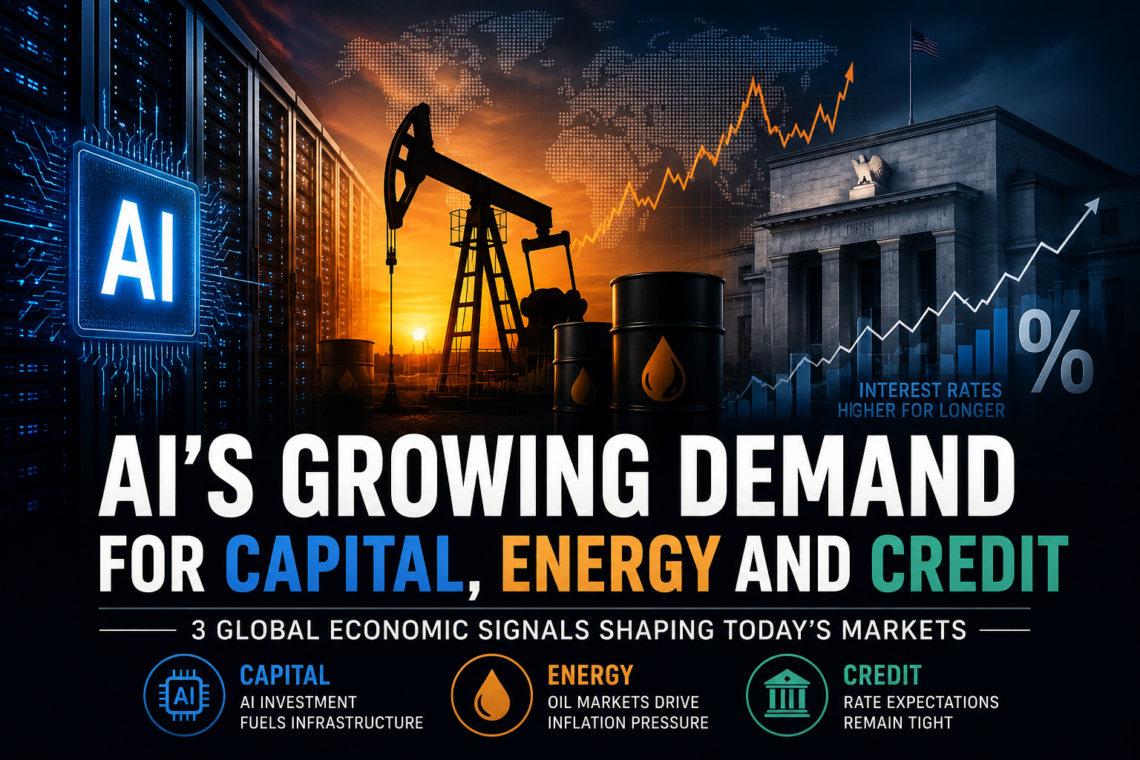
Signal 1. AI Debt Issuance Rises as Infrastructure Spending Moves Into Credit Markets
What’s happening:
- Global AI-related debt issuance is expected to increase as technology companies fund infrastructure expansion.
- Major technology and semiconductor shares remain closely tied to AI capital expenditure.
- Asian technology stocks rebounded after a sell-off linked to AI market volatility.
Why this matters:
AI investment is moving beyond equity-market valuation and into corporate financing structures. The build-out of data centres, chips, cloud capacity and related infrastructure requires capital that flows through credit markets, supply chains and equity indices. This makes AI spending a financial-system input rather than a sector-specific theme.
What elevates it:
- AI infrastructure demand is affecting corporate borrowing needs.
- Semiconductor and technology stocks remain linked to capital expenditure expectations.
- Market concentration is being shaped by companies connected to AI infrastructure.
Signal 2. Oil Prices Move as Middle East Supply Routes Remain Under Market Focus
What’s happening:
- Oil inventories are being monitored closely as energy markets assess supply availability.
- Oil prices moved as traders responded to Strait of Hormuz transit developments.
- U.S.–Iran tensions remained part of the market pricing discussion around energy supply.
Why this matters:
Oil remains a direct input into inflation, transport costs, industrial production and household expenditure. When supply routes become part of market pricing, energy costs transmit into broader economic assumptions. This connects geopolitical risk with inflation data, bond yields and central-bank communication.
What makes this critical:
- Energy supply conditions affect headline inflation inputs.
- Shipping-route uncertainty influences commodity-market pricing.
- Oil-market movements feed into financing-cost expectations.
Signal 3. Fed Rate-Cut Expectations Fade as Inflation Keeps Policy Assumptions Tight
What’s happening:
- A Reuters poll showed economists expect the Federal Reserve to hold rates this year.
- Bond markets remained focused on upcoming inflation data.
- Central-bank commentary and market pricing continued to reflect inflation sensitivity.
Why this matters:
Interest-rate expectations affect discount rates, borrowing costs, currency movements and asset valuations. When inflation remains central to policy assumptions, capital becomes more expensive across households, businesses and governments. This keeps financial conditions tied to input-cost pressures rather than growth expectations alone.
This breaks the usual playbook:
- Rate-cut assumptions are being constrained by inflation data.
- Energy and AI-related cost pressures are entering policy discussions.
- Bond markets are reacting to inflation inputs alongside growth signals.
Economic Audit
These signals collectively suggest a shift in the operating environment because the shared constraint is the cost of inputs required to sustain growth. AI infrastructure requires capital, chips, power and debt-market capacity; oil-market volatility affects energy costs, inflation and transport inputs; and central-bank policy remains linked to the same inflation-sensitive cost structure. The system is therefore not being shaped by demand alone, but by how capital, energy and physical infrastructure costs move through markets at the same time.
Calcufinder context
The Scenario Return Calculator is affected by expected return assumptions, inflation-rate inputs, contribution amounts, investment timeframe, and volatility assumptions.
Representative Sources
https://www.reuters.com/business/global-ai-debt-issuance-top-500-billion-2026-morgan-stanley-says-2026-06-10/
https://www.reuters.com/commentary/reuters-open-interest/global-markets-view-usa-2026-06-09/
https://www.ft.com/content/f9367c83-c291-4446-bf12-8282e5169812
https://www.reuters.com/business/energy/oil-inventories-are-headed-toward-multi-decade-lows-us-eia-warns-2026-06-09/
https://www.ft.com/content/c7e5bbbd-65ed-4678-baee-a4b63123e0e5
https://www.wsj.com/finance/commodities-futures/oil-rises-on-escalating-supply-disruption-concerns-c05bc14e
https://www.reuters.com/business/fed-hold-rates-this-year-cut-calls-fade-war-inflation-persists-economists-say-2026-06-09/
https://www.wsj.com/finance/jgbs-fall-tracking-declines-in-u-s-treasurys-98c6deb1
https://www.ft.com/content/2356f040-e8e8-4e8a-b0c3-40861643aab4
Coverage Signals
- Reuters coverage highlights how AI infrastructure spending is moving into corporate debt markets and reshaping financing needs.
- FT coverage reflects how AI-linked equity volatility is spreading across Asian technology markets.
- Reuters, FT and WSJ coverage frames oil as a transmission channel between Middle East developments, energy supply and inflation-sensitive markets.
- Reuters coverage indicates that economists are adjusting Federal Reserve rate expectations around inflation persistence rather than growth weakness.
- WSJ coverage reflects how bond markets are positioning around inflation data and central-bank assumptions.
- FT coverage connects Federal Reserve policy constraints with oil-price effects and inflation transmission.
Disclaimer: This article is for general information only and is not financial advice. You are responsible for your own financial decisions.

