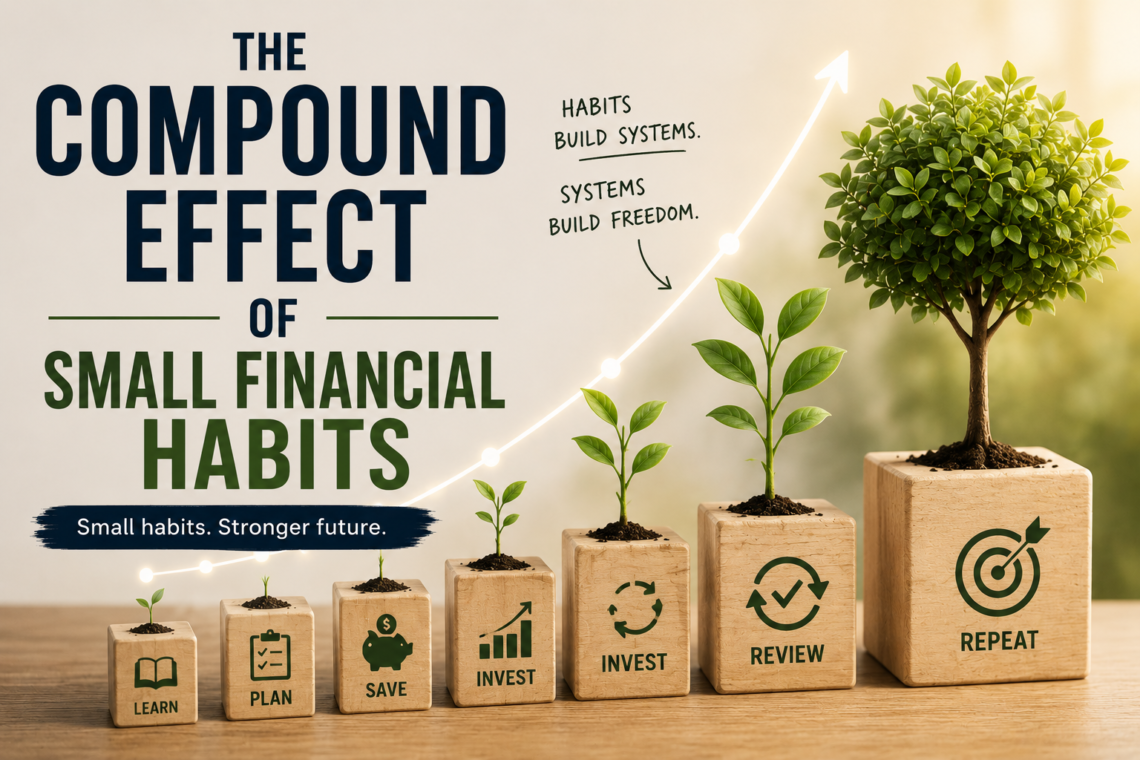
Compound growth is usually associated with money.
Returns build on previous returns.
Balances increase over time.
Financial behaviour follows a similar pattern.
Not because habits generate interest.
Because repeated behaviours make future behaviours easier.
The most valuable habit is rarely the largest.
It is often the one that quietly strengthens the next decision.
Section 1 — Core Mechanism of This Topic
Financial habits do not exist in isolation.
Each one changes the conditions for the next.
A single action may seem insignificant:
- reviewing spending once a week
- transferring money automatically
- investing on the same date each month
- checking progress periodically
None of these actions changes a financial outcome immediately.
Together, they change how the system operates.
Small habits reduce uncertainty.
Reduced uncertainty encourages repetition.
Repetition builds stability.
The effect compounds through behaviour before it compounds through money.
Section 2 — Where Habits Lose Their Effect
A habit rarely disappears all at once.
It weakens through interruption.
Small breaks begin to appear:
- reviews become less regular
- automatic transfers are postponed
- financial routines become occasional
- attention shifts elsewhere
The habit does not collapse.
It fades.
Each interruption appears temporary.
Repeated interruptions change the pattern.
The gap does not appear immediately.
It accumulates quietly.
Section 3 — The Missing Calculation
Financial projections often assume contributions continue.
They rarely measure the habits that make those contributions possible.
Two people may invest identical amounts.
One relies on repeated decisions.
The other relies on established routines.
The investment looks identical.
The behavioural system is not.
This is why examining how income translates into actual investable surplus through a scenario return calculator matters.
The missing variable is not contribution size.
It is habit accumulation.
Section 4 — Structural Framework
Strong financial habits rarely depend on motivation.
They depend on repetition.
Over time, small routines begin to connect:
- automatic saving supports investing
- regular reviews reduce uncertainty
- simple rules reduce hesitation
- consistent timing strengthens routine
Each habit supports another.
The system becomes more stable without becoming more complicated.
The framework is built one behaviour at a time.
Section 5 — Flexibility & Reality
Life does not preserve perfect routines.
Schedules change.
Income changes.
Responsibilities change.
Well-established habits adjust more easily because they already belong to everyday life.
The exact contribution may change.
The routine often survives.
That continuity becomes an advantage over time.
Section 6 — Decision Layer
Small financial habits gradually change how decisions are made.
Instead of asking:
“Should I save this month?”
The behaviour becomes:
“This is simply part of my routine.”
The system gradually requires:
- less attention
- fewer reminders
- fewer deliberate decisions
- less mental effort
The compound effect appears long before the investment balance reveals it.
Behaviour improves first.
Results follow later.
What Actually Compounds
Compound growth is usually measured in dollars.
Its earliest effect appears in behaviour.
Small financial habits create:
- stronger routines
- more reliable systems
- lower behavioural friction
- greater long-term consistency
Money compounds because behaviour continues.
Behaviour continues because the system becomes easier to repeat.
The goal is not perfection.
It is creating a structure that remains usable when conditions change.

