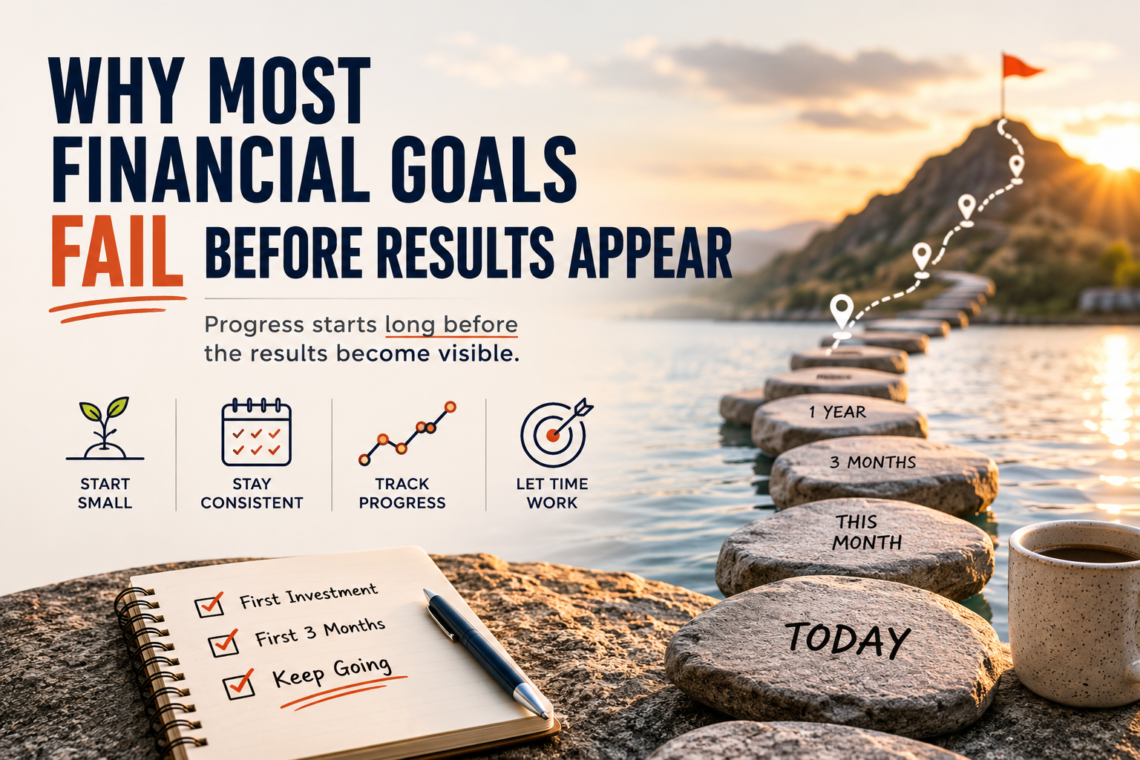
Most financial goals begin with a destination.
A portfolio target.
A retirement number.
A FIRE timeline.
The destination is rarely the problem.
The distance is.
Long-term goals often demand months, or even years, before visible progress appears.
Many plans lose momentum long before the numbers begin to change.
Section 1 — Core Mechanism of This Topic
Large financial goals create delayed feedback.
The first investment rarely feels meaningful.
Neither does the second.
Or the tenth.
The balance changes slowly.
The habit changes immediately.
This difference matters.
People naturally evaluate progress through visible results.
Financial progress often remains invisible during its earliest stage.
The system is improving.
The balance has not yet caught up.
Section 2 — Where Plans Lose Momentum
The earliest stage of a financial plan is often the quietest.
The routine exists.
The visible reward does not.
Behaviour begins to change:
- contributions become irregular
- reviews become less frequent
- motivation begins to depend on results
- progress is judged too early
The plan does not collapse.
It loses direction.
The gap does not appear immediately.
It accumulates quietly.
Section 3 — The Missing Calculation
Financial projections usually measure future wealth.
They rarely measure visible progress.
Two people may invest identical amounts.
One expects immediate evidence.
The other expects delayed outcomes.
The investment is identical.
The expectations are not.
This is why examining how income translates into actual investable surplus through a scenario return calculator matters.
The missing variable is not future value.
It is progress visibility.
Section 4 — Structural Framework
Long-term goals rarely provide immediate reinforcement.
Smaller milestones do.
A structure becomes easier to maintain when progress can be recognised through:
- completed contributions
- consistent participation
- repeated routines
- measurable continuity
The objective remains the same.
The feedback becomes closer.
The framework shifts attention from distant outcomes to present actions.
Section 5 — Flexibility & Reality
Real life rarely progresses in straight lines.
Neither do financial plans.
Income changes.
Expenses change.
Timelines change.
Progress may slow temporarily without disappearing.
A long-term objective survives more easily when success is measured through participation rather than speed.
Section 6 — Decision Layer
The way progress is measured influences future decisions.
When success depends only on a distant financial target:
- motivation becomes fragile
- delays feel like failure
- temporary setbacks appear permanent
When progress is measured through repeated actions:
- participation continues
- confidence grows gradually
- behaviour remains stable
The destination matters.
The next step matters more.
What Actually Sustains Long-Term Goals
Financial goals rarely fail because they are too ambitious.
They lose strength because early progress is difficult to recognise.
Large outcomes are built from small completed actions.
Each contribution.
Each review.
Each repeated habit.
Visible results arrive later.
Progress begins much earlier.
The goal is not perfection.
It is creating a structure that remains usable when conditions change.

