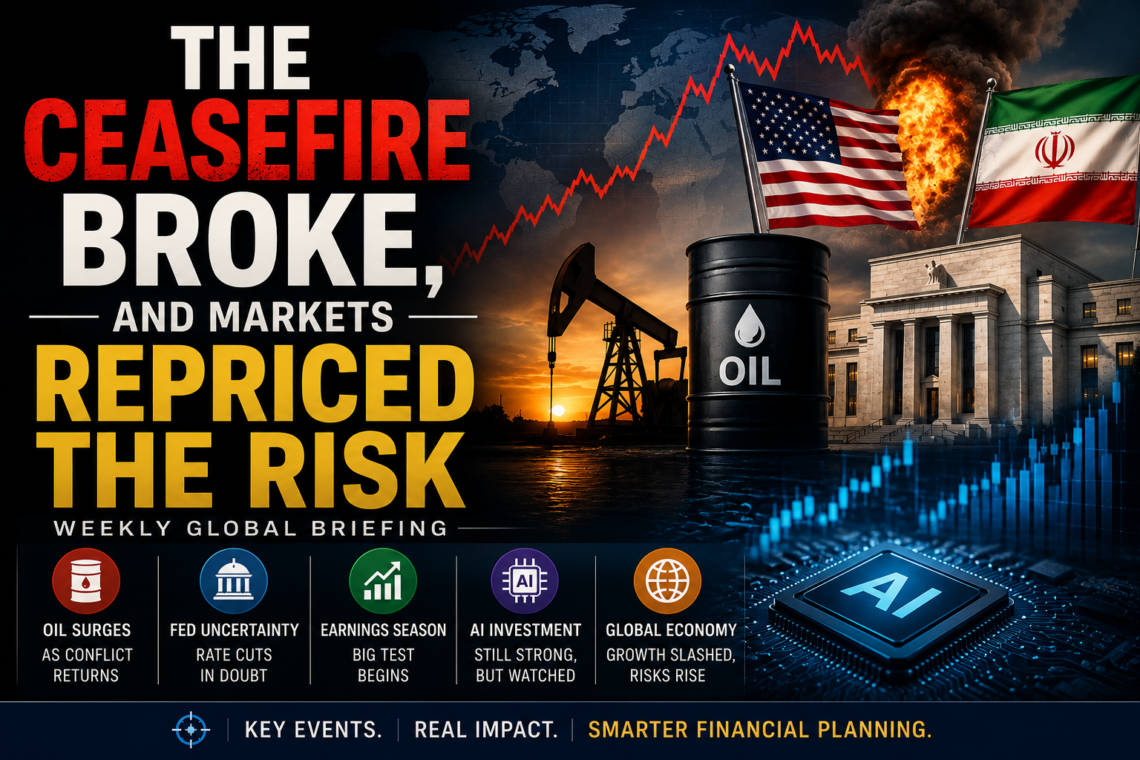
Global markets finished the week with an unusual combination: resilient equities, renewed oil volatility, firmer inflation concerns, and continued enthusiasm for AI infrastructure. The central tension is no longer whether growth exists. It is whether current valuations and financial plans leave enough room for growth to disappoint.
✔️ The IMF Cut Growth Again as Inflation Risks Returned
What’s Happening
The International Monetary Fund lowered its 2026 global growth forecast from 3.1% to 3.0% on 8 July. It expects growth to recover to 3.4% in 2027, but warned that renewed Middle East conflict, trade fragmentation, higher energy costs, and a correction in AI-related market expectations could weaken the outlook further.
The IMF also raised its 2026 global inflation forecast to 4.7%, reflecting higher energy prices following the Middle East conflict.
Why This Matters
The forecast describes an economy that is still growing, but with less protection against disruption.
A small reduction in expected growth may appear insignificant. However, weaker growth combined with higher inflation gives governments and central banks fewer easy policy choices. Supporting demand may worsen inflation, while tighter policy may weaken already modest growth.
What Elevates It
The IMF identified AI expectations as both a source of investment and a potential source of market instability.
That connection matters because the same sector supporting economic growth is also carrying increasingly demanding valuations. The risk is not that AI investment disappears, but that financial markets have already priced in more success than companies can deliver on schedule.
✔️ The Federal Reserve’s Debate Shifted Back Towards Rate Increases
What’s Happening
Minutes from the Federal Reserve’s 16–17 June meeting showed that concerns about persistent inflation had broadened. Policymakers noted price pressure across transportation, airfares, petrochemicals and agricultural inputs.
The Fed kept its policy rate at 3.50%–3.75%, although several participants were open to raising rates if inflation remained elevated. The meeting also marked a move away from detailed forward guidance under Chair Kevin Warsh.
A separate New York Fed study found that many businesses had not finished passing higher tariff costs on to customers, suggesting that some inflation pressure may still be moving through supply chains.
Why This Matters
Markets had been debating when interest rates might fall. The more relevant question is now whether they may have to rise again.
That changes the financial environment for mortgages, corporate borrowing, bond prices and equity valuations. Assets priced around steadily declining rates become more vulnerable when the direction of policy is uncertain.
What Elevates It
The inflation pressure is not coming from one source alone.
Energy disruption, tariffs and heavy AI-related investment can all raise prices through different channels. Even if one pressure eases, the others may prevent inflation from returning smoothly to target.
✔️ The Ceasefire Has Broken Down, and Energy Markets Are Responding
What’s Happening
The fragile U.S.–Iran ceasefire has effectively broken down after both countries resumed military strikes. Fighting has again centred on the Strait of Hormuz, with attacks on shipping and renewed concerns over one of the world’s most important energy routes. Oil prices jumped more than 3% as markets reacted to the escalation.
Why This Matters
The Strait of Hormuz carries around one-fifth of global oil trade. Any disruption affects not only crude prices but also inflation expectations, shipping costs, and the outlook for interest rates. Markets are once again pricing geopolitical risk into energy assets.
What Elevates It
The concern is no longer simply higher oil prices.
The breakdown of the ceasefire reminds investors that geopolitical agreements can unravel quickly, forcing markets to reassess inflation, supply chains, and global growth assumptions within days.
✔️ AI Enthusiasm Survived Another Test
What’s Happening
SK Hynix shares rose 14% in their Nasdaq debut following a US$26.5 billion share sale. The offering was more than seven times oversubscribed, demonstrating continued demand for companies supplying high-bandwidth memory used in AI systems.
Meta also plans to begin production of its internally designed Iris AI chip in September. The company is seeking to double its computing capacity from 7 gigawatts in 2026 to 14 gigawatts in 2027 and expects to spend as much as US$145 billion on AI infrastructure this year.
Why This Matters
AI is moving from a software narrative into physical infrastructure.
The investment now requires semiconductor capacity, electricity, data centres, memory, networking equipment and long-term supply agreements. This broadens the economic impact, but it also raises the amount of capital that must eventually earn an adequate return.
What Elevates It
The market is still rewarding exposure to AI capacity, but the expectations are becoming harder to satisfy.
SK Hynix’s strong debut shows that investor appetite remains substantial. At the same time, rapid valuation increases and enormous capital expenditure create a wider gap between enthusiasm today and the profits required tomorrow.
✔️ Investors Turned from AI Announcements to Financial Results
What’s Happening
Wall Street ended Friday higher as investors prepared for the second-quarter reporting season. The S&P 500 rose 0.42%, while the Nasdaq and Dow each gained 0.29%.
Analysts expect S&P 500 earnings to rise by approximately 24% year on year, with major U.S. banks and TSMC among the companies due to provide important evidence about financial activity and AI-related semiconductor demand.
Despite geopolitical tension, technology shares continued to support the market. However, Reuters noted that recent volatility and profit-taking had exposed concerns about stretched semiconductor valuations.
Why This Matters
Markets have already paid for a significant amount of future growth.
The reporting season must now show whether revenue, margins and cash flow are rising quickly enough to support those prices. Strong results may extend the rally, but merely meeting expectations may not be sufficient when expectations are already high.
What Elevates It
This is not simply an earnings test for a few technology companies.
Bank results will show whether consumers and businesses remain financially resilient. Semiconductor results will test AI demand. Company guidance will reveal whether tariffs, energy costs and financing conditions are beginning to affect future plans.
✔️ What This Means for Financial Planning
This week did not produce one dominant direction. It produced a narrower path.
Economic growth continues, corporate earnings are expected to rise, and AI investment remains powerful. Yet inflation risks have returned, central banks have less freedom to reduce rates, and geopolitical events can alter market assumptions within days.
For financial planning, several implications stand out.
Do not treat lower future interest rates as a certainty. Mortgage, debt-repayment and investment plans should remain workable if rates stay elevated—or rise modestly—rather than depending on rapid cuts.
Separate a strong industry from an automatically safe investment. AI may continue transforming the economy while individual AI-linked assets still experience valuation corrections.
Use contribution assumptions you can sustain through volatility. A plan built around regular investing should not require favourable headlines every month.
Preserve liquidity outside the investment portfolio. Emergency reserves reduce the chance that a temporary market decline, higher bill or income interruption forces assets to be sold at the wrong time.
The practical lesson is not to predict which risk will arrive next. It is to build a structure that does not break when several risks arrive together.
✔️ Relevant Calcufinder Reading
What Makes a Financial Plan Work in Real Life – Markets can change quickly. The real test of a financial plan is not how it performs under ideal conditions, but whether it can continue when conditions change.
✔️ Related Calculator Idea
Investment vs Debt Payoff Calculator – With inflation concerns rising and the Federal Reserve again discussing possible rate increases, readers can compare the guaranteed benefit of reducing debt with the uncertain return from investing additional cash.
✔️ Representative Source
https://www.reuters.com/business/fed-minutes-due-analysts-debate-whether-warsh-will-curtail-them-2026-07-08/
https://www.reuters.com/business/ny-fed-says-firms-its-district-arent-done-passing-tariff-costs-2026-07-08/
https://www.reuters.com/world/asia-pacific/sk-hynix-set-marquee-us-debut-test-ai-appetite-2026-07-10/
https://www.reuters.com/world/asia-pacific/meta-put-ai-chip-into-production-september-it-looks-double-computing-capacity-2026-07-09/
https://www.reuters.com/business/media-telecom/sp-500-nasdaq-futures-slip-investors-eye-sk-hynix-listing-middle-east-risks-2026-07-10/
https://www.reuters.com/business/take-five/global-markets-themes-graphic-2026-07-10/
https://www.reuters.com/business/wall-st-futures-rebound-oil-retreats-investors-weigh-us-iran-tensions-2026-07-09/
https://www.reuters.com/business/energy/oil-jumps-more-than-3-after-us-iran-launch-strikes-mideast-2026-07-12/
https://www.reuters.com/world/middle-east/iran-targets-sites-bahrain-kuwait-after-wave-us-strikes-2026-07-08/
https://www.reuters.com/world/middle-east/us-insists-iran-commit-stopping-attacks-hormuz-strait-say-us-officials-2026-07-10/
https://www.reuters.com/business/energy/tanker-traffic-slows-strait-hormuz-after-us-iran-clashes-2026-07-10/
Disclaimer: This article is for general information only and is not financial advice. You are responsible for your own financial decisions.

