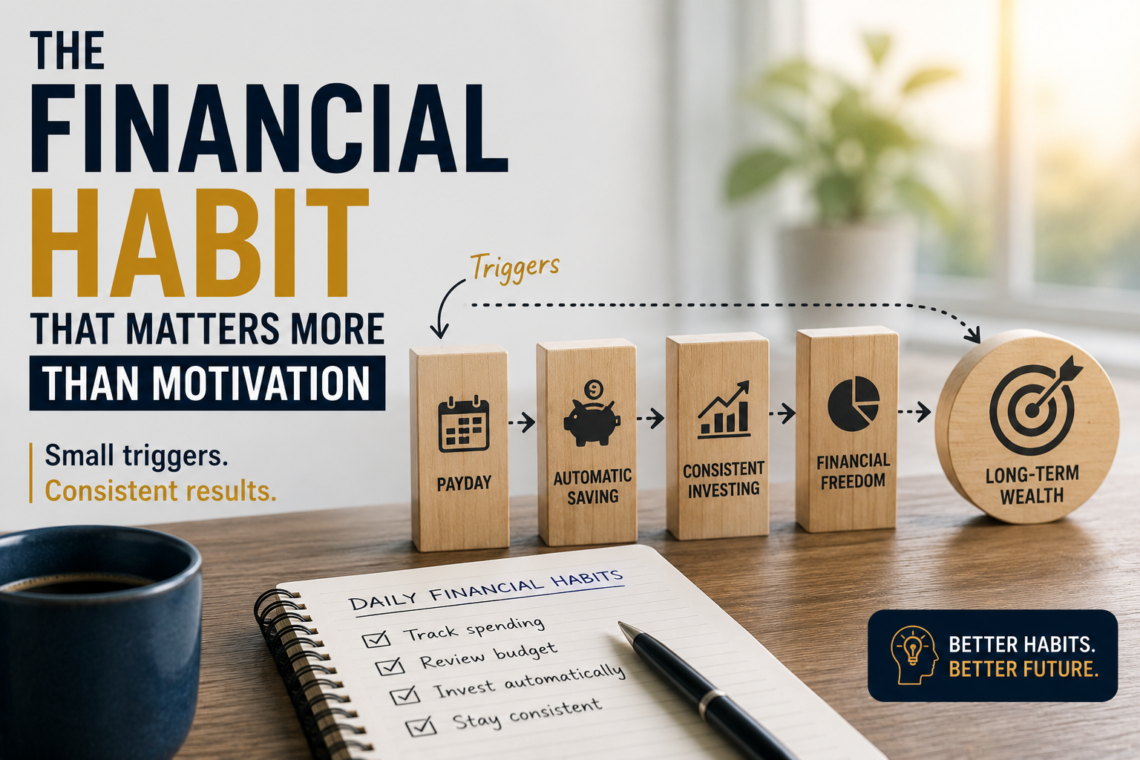
Most people wait until they feel motivated to improve their finances.
The difficulty is that motivation rarely follows a predictable schedule.
Some months it feels effortless.
Other months it disappears completely.
Yet certain financial habits continue regardless.
Not because motivation remains.
Because something else starts the behaviour.
Section 1 — Core Mechanism of This Topic
Long-term financial habits usually begin with a trigger.
Not a feeling.
A trigger removes the need to decide when to act.
The action simply follows a familiar signal.
Examples include:
- payday triggers an automatic investment
- Sunday evening triggers a budget review
- receiving a bill triggers a spending check
- the first day of the month triggers a portfolio update
The habit no longer waits for motivation.
It responds to routine.
Consistency grows because the behaviour has a starting point.
Not because enthusiasm remains.
Section 2 — Where Plans Break
Financial habits become fragile when they rely on emotion.
The pattern is familiar:
- “I’ll invest when I feel ready.”
- “I’ll review my budget next week.”
- “I’ll start again next month.”
Nothing has changed except the trigger.
There isn’t one.
The plan does not collapse.
It waits.
The gap does not appear immediately.
It accumulates quietly.
Section 3 — The Missing Calculation
Financial plans often calculate contributions.
They rarely consider what causes those contributions to happen.
Two people may invest the same amount.
One depends on remembering.
The other depends on a repeated trigger.
The numbers look identical.
The behavioural system does not.
This is why examining how income translates into actual investable surplus through a cost of living planning calculator matters.
The missing variable is not affordability.
It is behavioural reliability.
Section 4 — Structural Framework
Strong financial habits usually contain three parts:
- a clear trigger
- a repeatable action
- a predictable outcome
When one part disappears, the habit becomes less stable.
The action matters.
The trigger often matters more.
Reliable systems begin before the behaviour itself.
Section 5 — Flexibility & Reality
Triggers naturally change throughout life.
A new job changes payday.
Parenthood changes daily routines.
Working from home changes schedules.
The behaviour does not need to disappear.
The trigger simply needs to change with it.
Adaptation protects continuity.
Section 6 — Decision Layer
Financial habits become easier when they begin automatically.
Instead of asking,
“Should I do this today?”
The question disappears.
The environment has already answered it.
Less attention is required.
Less negotiation occurs.
More consistency follows.
The strongest financial habits are rarely powered by motivation.
They are supported by reliable triggers.
What Actually Makes Financial Habits Last
Motivation can begin a financial habit.
It rarely sustains one.
Long-term consistency depends on reducing the need to decide.
A repeated trigger makes repeated behaviour more likely.
Repeated behaviour eventually becomes part of everyday life.
Financial habits become easier not because people become more motivated, but because the environment quietly reminds them what to do next.
The goal is not perfection.
It is creating a structure that remains usable when conditions change.
