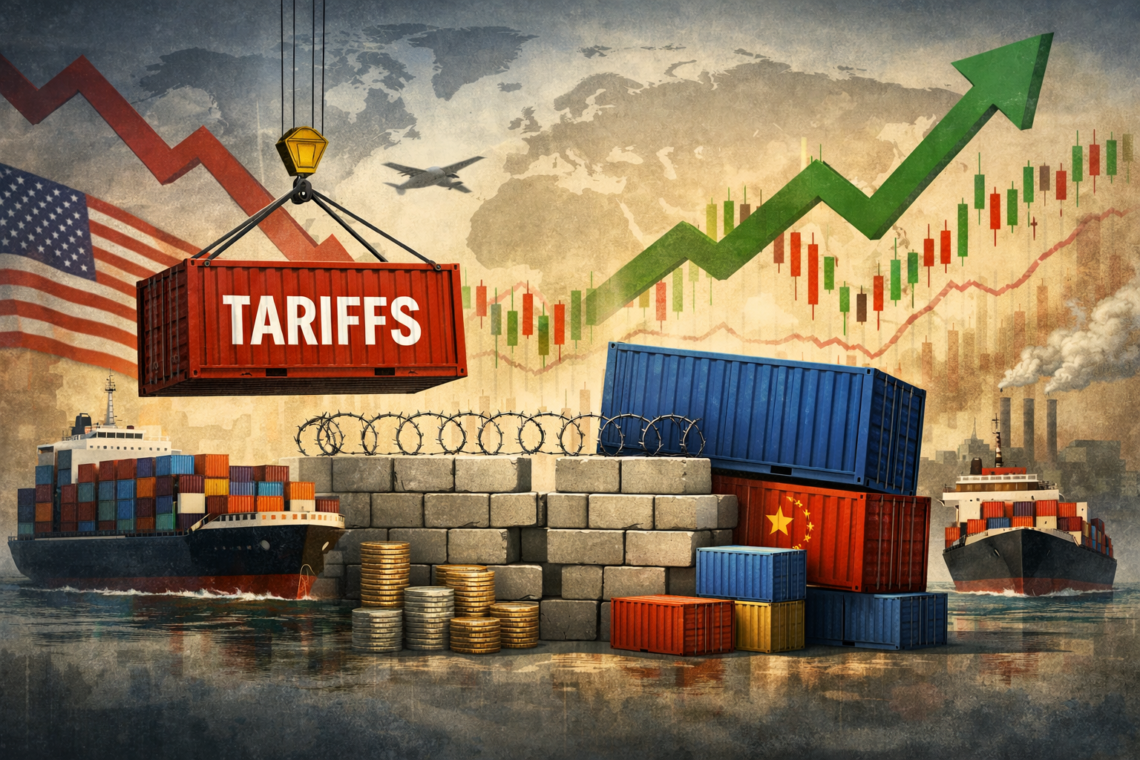
For much of 2025, the story many people heard sounded dramatic: tariffs returned, global trade was “shaken,” markets were rattled, and uncertainty re-entered the economic conversation. The narrative implied a sharp break from the past and hinted at lasting damage to global growth.
That story isn’t entirely wrong—but it’s incomplete.
To understand what this period really means for real-world decisions, it helps to step back from the headlines and look at incentives, adjustments, and longer-term patterns rather than short-term disruption.
What the Data Actually Says
Multiple reports toward the end of 2025 confirmed that average U.S. import tariffs rose to their highest level in decades, driven by a broad set of levies on trading partners. According to Reuters, these measures lifted effective import taxes to levels not seen since the early 20th century, generated substantial fiscal revenue, and forced renewed negotiations over trade and investment frameworks. (Source: Reuters)
At the same time, Bloomberg reporting and IMF assessments show something equally important: global trade volumes slowed in some corridors but did not collapse. Supply chains adjusted, pricing shifted, and businesses absorbed costs through a mix of margin compression, sourcing changes, and selective price increases. (Sources: Bloomberg, IMF)
In other words, the system bent—but it did not break.
Why This Matters Now (and Why It’s Not Just About Trade)
Tariffs are rarely about tariffs alone. They are policy signals.
In 2025, trade policy functioned as a lever to reshape negotiating power, encourage domestic investment, and force counterparties to reconsider dependency structures. That signal matters more than the precise tariff percentage because it influences how companies plan multi-year investments.
The deeper implication is this:
global trade is no longer optimised purely for efficiency—it is being optimised for resilience and control.
That shift has consequences:
- Firms prioritise supply security over lowest cost
- Capital spending decisions factor in policy durability
- Long-term contracts increasingly price in political risk
These effects unfold slowly, not overnight, which is why they’re easy to miss if you only track market reactions.
Common Misconceptions Worth Clearing Up
One widespread assumption is that higher tariffs automatically lead to runaway inflation or immediate economic contraction. The evidence from 2025 doesn’t support that simplification.
• Inflation impact was uneven, not universal. Some goods saw price pressure; others didn’t.
• Consumers adjusted behavior, substituting rather than stopping consumption.
• Companies shared the burden, absorbing costs rather than passing them through entirely.
Another misconception is that trade friction reverses globalisation. In practice, it often re-routes it. Manufacturing, logistics, and capital flows shift locations, but global interdependence remains—just expressed differently.
Second-Order Effects That Matter More Than the Headlines
The most important consequences of the past year weren’t the tariffs themselves, but what they accelerated:
1. Supply-chain diversification
Businesses moved from single-source efficiency to multi-source resilience.
2. Regionalisation of trade
Trade blocs tightened internally even as cross-bloc trade slowed.
3. Investment selectivity
Capital favoured projects with pricing power, flexibility, and local demand.
These dynamics align with longer-running trends identified by the OECD and World Bank, which have repeatedly warned that trade policy uncertainty influences investment decisions more than trade volumes themselves. (Sources: OECD, World Bank)
Who Is Actually Affected—and Who Is Not
This distinction matters for personal decision-making.
More affected:
- Export-heavy businesses with thin margins
- Firms dependent on narrow supply chains
- Regions reliant on policy-sensitive trade flows
Less affected:
- Businesses serving local or diversified demand
- Companies with pricing power or flexible sourcing
- Households with balanced income and spending exposure
- For individuals, this doesn’t translate into a need for constant reaction—but it does reinforce the value of flexibility in income, skills, and financial structure.
If you’ve ever sanity-checked how exposed your own plans are to regional or sector concentration, this is exactly the kind of environment where that reflection becomes useful. A broader view of diversification—not just in assets but in opportunity—matters more than predicting policy outcomes.
The Longer-Term Trend Behind the Noise
Zooming out, the past year fits into a bigger pattern:
- Governments are more willing to use economic tools strategically
- Markets are learning to price political durability, not just growth
- Trade remains global, but less friction-blind
The IMF has repeatedly emphasised that future growth will depend less on maximizing cross-border flows and more on managing transitions—energy, demographics, technology—without destabilising domestic systems. (Source: IMF)
From that perspective, 2025 looks less like an anomaly and more like a transitional phase.
A Calmer Way to Read the Outlook
It’s tempting to view trade tension as a binary threat: escalation or resolution. Reality is usually quieter. Policy changes raise costs, then systems adapt. Markets price uncertainty, then move on. Life decisions made on flexibility tend to age better than those built on certainty.
The key takeaway isn’t that trade risk disappeared—or that it dominates everything. It’s that economic systems absorb shocks gradually, and thoughtful planning focuses on adaptability rather than prediction.
Understanding that distinction is often the difference between reacting to noise and responding to signal.
Disclaimer: This article is for general information only and is not financial advice. You are responsible for your own financial decisions.

