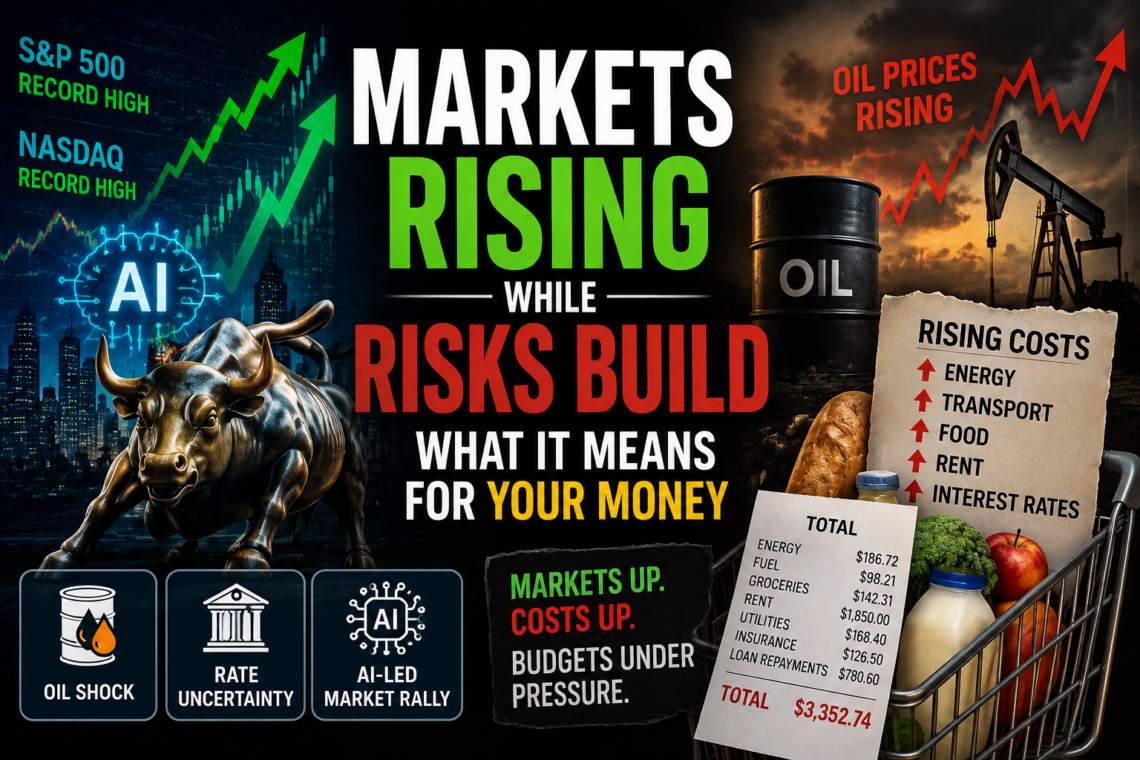
Signal 1. Oil shock and Middle East escalation are driving global market risk
What’s happening:
- Oil prices rose after renewed attacks and supply risks around the Strait of Hormuz.
- Brent crude moved above $110 as vessels and energy infrastructure were affected.
- Energy supply concerns are feeding into inflation expectations and market volatility.
Why this matters:
Oil is acting as the first transmission point in the current market environment. When supply risk rises around a critical shipping route, energy costs can move into transport, production, and trade pricing. That creates a link between geopolitical disruption, inflation assumptions, and broader financial conditions.
What elevates it:
- The trigger is tied to supply disruption rather than demand conditions
- The effect reaches energy, currencies, equities, and inflation expectations
- A key trade route is shaping global cost assumptions
Signal 2. Central bank uncertainty is returning as inflation pressure persists
What’s happening:
- Higher energy prices are complicating expectations for future rate cuts.
- Bond yields and currency markets are reacting to inflation and policy uncertainty.
- Investors are reassessing the path of central bank decisions as oil-driven cost pressure remains in focus.
Why this matters:
Monetary policy becomes harder to interpret when inflation pressure comes from supply conditions. Central banks have less room to respond to slower growth if energy costs continue to influence price expectations. This affects borrowing costs, currency positioning, and valuation assumptions across markets.
What makes this critical:
- Rate expectations are being shaped by external cost pressure
- Borrowing costs remain connected to inflation sensitivity
- Currency and bond markets are adjusting alongside energy prices
Signal 3. AI-led stock gains are diverging from macro risk
What’s happening:
- The S&P 500 and Nasdaq reached record highs, supported by AI-linked and semiconductor stocks.
- Chip-related shares rose as investors focused on earnings and AI demand.
- Equity gains occurred while oil, currency, and geopolitical risks remained active.
Why this matters:
Markets are not moving through one single narrative. AI-related earnings momentum is supporting equities while energy and policy risks continue to affect inflation and financial conditions. This creates a split between sector optimism and macro constraint.
This breaks the usual playbook:
- Equity strength is occurring alongside energy and policy uncertainty
- AI-linked gains are offsetting broader macro concerns
- Market leadership is concentrated while cross-asset risks remain active
Economic Audit
These signals collectively suggest a shift in the operating environment rather than a continuation of the prior baseline, because they describe one constraint moving through the system from energy supply disruption into inflation sensitivity, then into central bank uncertainty, and finally into market divergence. The shared constraint is reduced adjustment capacity: energy prices remain exposed to geopolitical disruption, policy expectations adjust around inflation risk, and equity markets separate into areas supported by AI earnings while broader financial conditions remain tied to oil, yields, and currency movements.
Calcufinder context
Cost of living planning calculator — the primary variables affected in this environment are energy cost inputs, inflation sensitivity, household expense variability, borrowing cost exposure, and income stability as oil disruption, policy uncertainty, and market divergence move into everyday cost structures.
Representative Sources
- Reuters: https://www.reuters.com/business/energy/oil-falls-after-trump-says-us-would-help-free-ships-stranded-strait-hormuz-2026-05-03/
- Reuters: https://www.reuters.com/world/china/global-markets-global-markets-2026-05-05/
- Reuters: https://www.reuters.com/business/us-stock-futures-rise-oil-dips-middle-east-tensions-linger-2026-05-05/
Coverage Signals
- Reuters coverage highlights how Strait of Hormuz disruption risk is feeding into oil prices, inflation assumptions, and broader market pricing.
- Reuters market coverage reflects the tension between AI-led equity gains and unresolved macro risks from energy and currencies.
- Broader financial media coverage is framing the current environment as a split between technology-driven earnings momentum and policy-sensitive cost pressure.
Disclaimer: This article is for general information only and is not financial advice. You are responsible for your own financial decisions.

