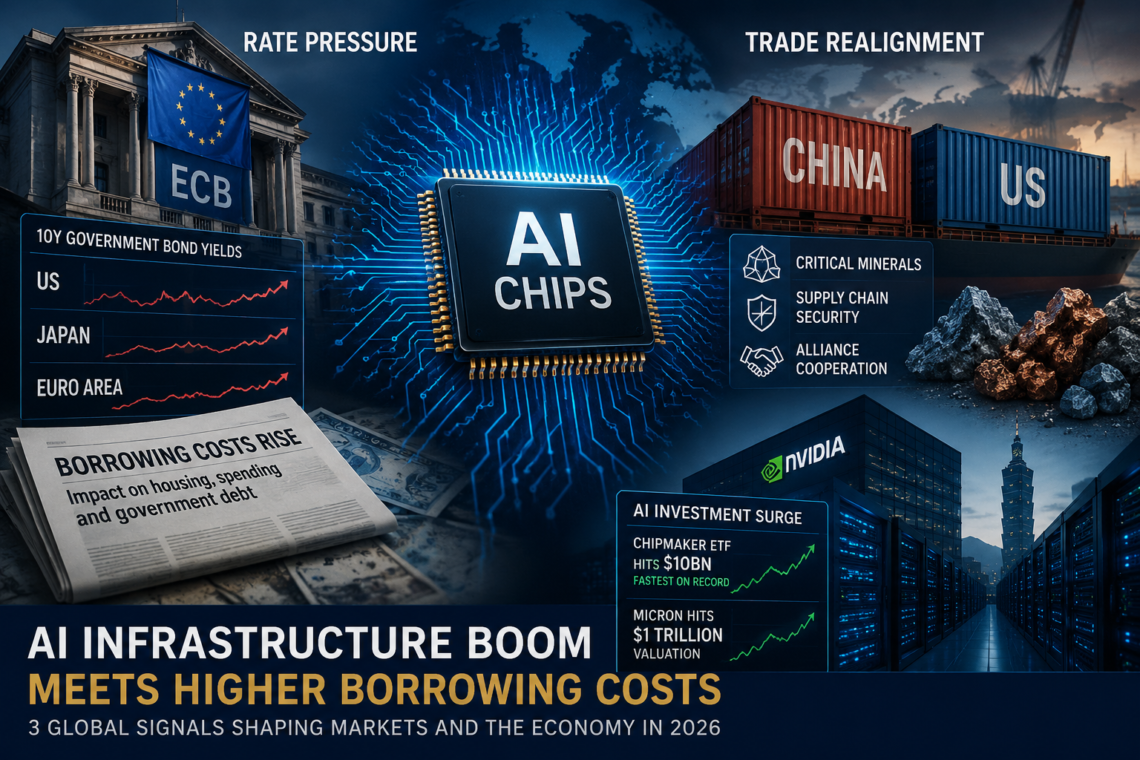
Signal 1. ECB Rate-Hike Comments and U.S. Treasury Pressure Keep Rate-Cut Expectations Constrained
What’s happening:
- ECB board member Isabel Schnabel said the European Central Bank should raise rates in June, citing energy-driven inflation pressure.
- U.S. Treasury market coverage focused on higher borrowing costs and their effect on housing, consumer spending, and government financing.
- WSJ market coverage highlighted higher superlong Japanese government bond yields linked to inflation expectations.
Why this matters:
Rate expectations are being shaped by inflation transmission rather than by growth indicators alone. Higher sovereign yields move through mortgage pricing, fiscal interest costs, and corporate refinancing channels at the same time. This makes monetary flexibility more conditional across developed markets.
What elevates it:
- Energy-linked inflation remains part of the policy discussion.
- Long-term borrowing costs are affecting both public and private balance sheets.
- Bond market pressure is appearing across more than one major developed market.
Signal 2. U.S. Tariff Review and Critical Minerals Policies Keep Trade Realignment in Focus
What’s happening:
- The U.S. said it would seek public comment on which Chinese goods may qualify for tariff reductions.
- Reuters reported that Western governments are funding critical mineral supply projects to reduce dependence on China.
- Quad foreign ministers announced agreements on critical minerals and energy security linked to supply-chain resilience.
Why this matters:
Trade policy is increasingly moving through specific goods, strategic minerals, and supply-chain access rather than broad tariff settings alone. This changes how firms assess sourcing, inventory, and production location. Critical minerals connect trade policy directly to energy systems, defence supply chains, and semiconductor production.
What makes this critical:
- Tariff policy remains tied to strategic classification of goods.
- Critical minerals are being treated as supply-chain infrastructure.
- Trade alignment is moving through alliances as well as bilateral negotiations.
Signal 3. Nvidia Taiwan Investment and Chipmaker ETF Surge Extend AI Market Concentration
What’s happening:
- Reuters reported that Nvidia’s chief executive said Taiwan is the “epicentre” of the AI revolution and outlined large annual spending plans in Taiwan.
- FT reported that an ETF focused on AI
- 1 trillion valuation as AI demand supported memory-chip shares.
Why this matters:
AI-related capital is concentrating in hardware, memory, chip manufacturing, and Taiwan-linked supply chains. Equity flows are therefore being shaped by infrastructure exposure rather than broad market participation. This creates a link between technology valuations, semiconductor capacity, and geopolitical production geography.
This breaks the usual playbook:
- AI-linked equity flows remain concentrated in a narrow part of the market.
- Semiconductor infrastructure is receiving capital despite higher financing costs.
- Market leadership is tied to physical production capacity, not software exposure alone.
Economic Audit
These signals collectively suggest a shift in the operating environment, not just reinforcement of an existing baseline. The shared constraint is the cost of securing access: access to capital through higher yields, access to strategic inputs through tariff and minerals policy, and access to computing infrastructure through AI-linked semiconductor investment. Inflation pressure limits monetary flexibility, trade realignment changes sourcing costs, and AI concentration directs capital towards infrastructure-heavy sectors. The system is moving around financing cost, supply security, and capital concentration as connected constraints.
Calcufinder context
The global portfolio allocation calculator is affected by input variables including sovereign bond yields, inflation assumptions, regional equity exposure, semiconductor sector weighting, currency exposure, and China-linked supply-chain concentration.
Representative Sources
- Reuters
- FT
— https://www.ft.com/content/95415dfc-904e-4ce5-a457-f50041c07ec9
- WSJ
— https://www.wsj.com/livecoverage/stock-market-today-dow-sp-500-nasdaq-05-26-2026
Coverage Signals
- Reuters coverage highlights how inflation, borrowing costs, critical minerals, and AI infrastructure are being framed as linked constraints across capital markets and supply chains.
- WSJ coverage reflects market attention on higher bond yields and the way inflation expectations are moving through sovereign debt markets.
- FT coverage indicates that AI equity demand is increasingly concentrated in semiconductor-linked investment vehicles rather than broad technology exposure.
Disclaimer: This article is for general information only and is not financial advice. You are responsible for your own financial decisions.

