Markets often react as though uncertainty arrives and disappears in a single event.
Reality is usually different.
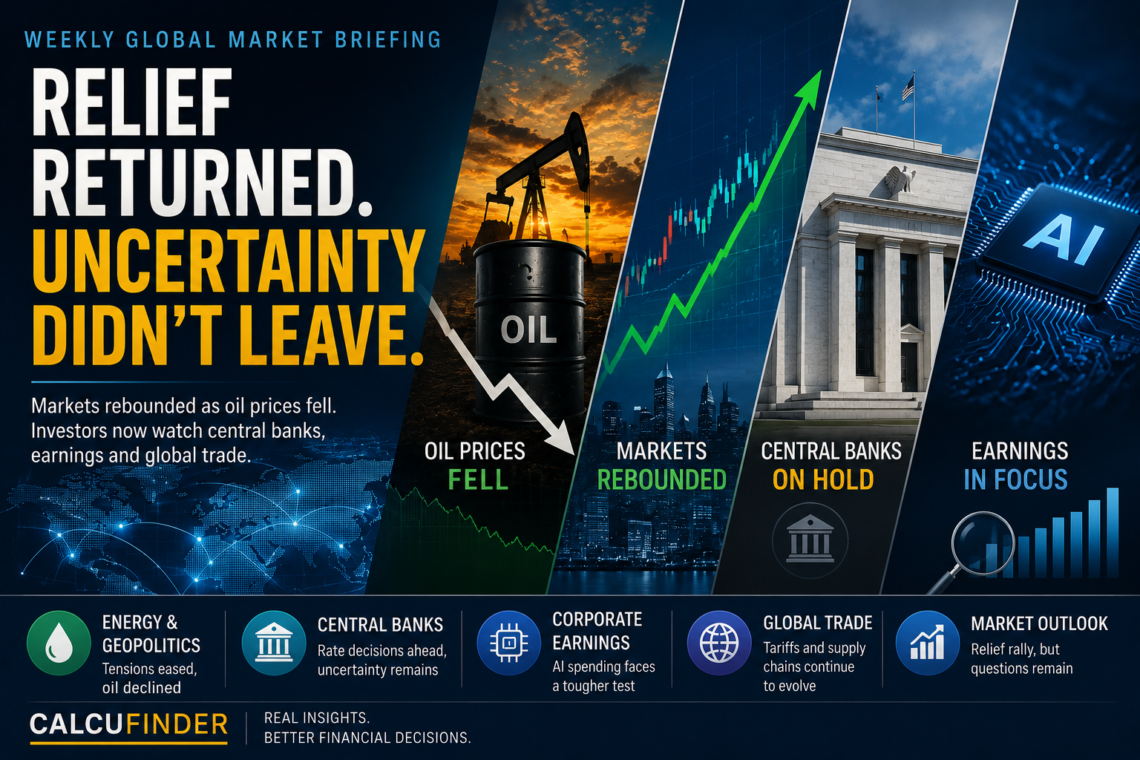
This week, easing tensions in the Middle East pushed oil prices sharply lower and lifted global equities. Bond yields eased, and investors regained confidence after several weeks of geopolitical anxiety. Yet beneath the relief, the same structural questions remained.
Central banks still face inflation risks.
Technology companies still need to justify unprecedented AI investment.
Trade tensions continue to reshape global supply chains.
The headlines became calmer.
The underlying conditions did not.
✔️ Oil Fell, but Energy Risk Didn’t
What’s Happening
Global markets rallied after the United States and Iran paused direct military action, reducing immediate concerns over disruptions to the Strait of Hormuz. Brent crude fell from above US$100 to around US$91 per barrel, easing fears of another inflation shock.
Why This Matters
Oil influences far more than fuel prices.
It affects:
- transport costs
- manufacturing
- inflation expectations
- household spending
- business margins
Lower oil prices immediately improve market sentiment because they reduce pressure across multiple parts of the economy.
What Elevates It
Markets celebrated the decline in oil prices.
The supply risk, however, remains.
The Strait of Hormuz and Red Sea shipping routes continue to face intermittent threats, meaning energy markets remain vulnerable to sudden repricing.
✔️ Central Banks Are Waiting for Clearer Evidence
What’s Happening
This week brings policy meetings from the Federal Reserve, Bank of England and Bank of Japan.
Markets broadly expect rates to remain unchanged, although the Federal Reserve is now viewed as facing one of its most uncertain decisions this year following recent oil volatility.
Why This Matters
Markets no longer expect interest-rate cuts simply because inflation has slowed.
Instead, policymakers are weighing:
- energy prices
- labour markets
- inflation persistence
- economic growth
One improvement does not automatically outweigh another emerging risk.
What Elevates It
The conversation has shifted.
Rather than asking “When will rates fall?”
Markets are asking
“How long must rates remain restrictive?”
That difference changes borrowing costs, investment valuations and business planning.
✔️ The AI Story Now Needs Financial Proof
What’s Happening
Nearly one-third of the S&P 500 reports earnings this week, including Microsoft, Apple, Amazon and Meta.
Analysts expect strong profit growth, but investor attention has shifted beyond revenue towards capital expenditure and free cash flow.
Why This Matters
AI investment remains one of the strongest drivers of global equity markets.
Yet large capital expenditure programmes require time before they generate sustainable returns.
Higher revenue alone is becoming less convincing.
What Elevates It
Last year, announcing AI investment often increased valuations.
This year, investors increasingly expect companies to demonstrate:
- operating leverage
- cash generation
- return on investment
- sustainable margins
Markets are beginning to distinguish between technological leadership and financial performance.
✔️ Trade Is Becoming a Permanent Constraint
What’s Happening
While attention shifted toward geopolitics, businesses continue adapting to higher tariffs and changing global supply chains.
Manufacturers remain cautious as companies evaluate where future production should be located and how costs should be managed.
Why This Matters
Trade policy affects planning long before it affects economic data.
Businesses must decide whether to:
- relocate production
- diversify suppliers
- absorb higher costs
- pass costs to customers
These decisions shape investment for years rather than weeks.
What Elevates It
Trade uncertainty no longer appears temporary.
It has become another structural assumption businesses must incorporate into long-term planning alongside labour shortages, energy costs and higher interest rates.
✔️ Markets Recovered. Expectations Became More Selective.
What’s Happening
Global equities rose as oil prices declined, while government bonds also strengthened.
Investors rotated back into technology shares ahead of earnings, although optimism remained measured rather than broad-based.
Why This Matters
Market recoveries often appear stronger than the underlying economic improvement.
Prices respond quickly.
Economic conditions usually change much more slowly.
What Elevates It
The market is no longer reacting to one dominant narrative.
Instead, investors are balancing several competing forces simultaneously:
- lower oil prices
- persistent inflation risk
- central-bank uncertainty
- AI earnings
- geopolitical developments
The challenge is not identifying a single risk.
It is understanding how multiple risks interact.
✔️ What This Means for Financial Planning
Financial plans rarely fail because one assumption changes.
They become difficult to maintain when several assumptions move together.
Lower oil prices improve household cash flow.
Higher interest rates may still persist.
Strong equity markets can continue while investment returns become increasingly concentrated in a small group of companies.
This is why long-term planning should rely less on predicting the next headline and more on building flexibility into the structure.
Review whether your plan can continue if:
- interest rates remain higher for longer
- monthly expenses temporarily increase
- investment returns become uneven across sectors
- contributions need to pause for several months
A sustainable financial plan does not depend on markets remaining calm.
It remains functional even after conditions change.
✔️ Related Calcufinder Tool
Scenario Return Calculator – Compare how changes in investment returns, inflation and monthly contributions affect long-term outcomes under different market conditions.
✔️ Further Reading
Why Having Cash Creates More Options Than Higher Returns – Periods of market relief often create the impression that uncertainty has disappeared. In practice, cash provides flexibility precisely because conditions can change again before expectations do.
✔️ Representative Sources
https://www.reuters.com/world/china/global-markets-wrapup-1-2026-07-27/
https://www.reuters.com/business/growing-number-brokerages-see-july-fed-decision-a-close-call-2026-07-27/
https://au.investing.com/news/economy-news/wall-st-futures-rise-as-us-iran-pause-hostilities-4553224?
https://au.investing.com/news/economy-news/take-five-a-crude-summer-4553116?
https://au.investing.com/news/stock-market-news/shares-bonds-bounce-as-oil-skid-offers-inflation-relief-4552818?
https://www.theguardian.com/business/2026/jul/27/oil-prices-fall-us-strikes-iran-brent-crude-bp-shell-ftse-100?
Disclaimer: This article is for general information only and is not financial advice. You are responsible for your own financial decisions.

